
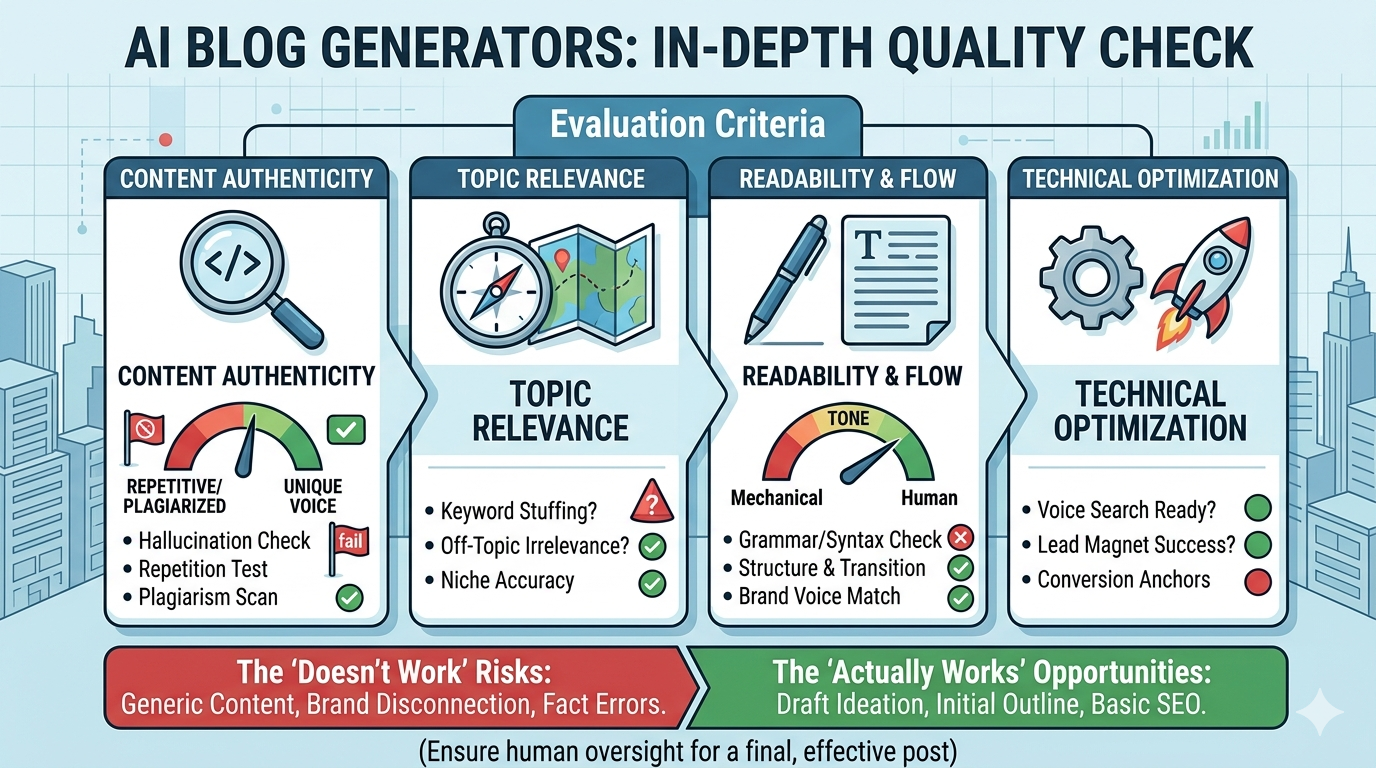
About This Article Everyone says AI will transform content creation. Fewer people tell you exactly how to use it without producing blog posts that sound like they were written by a robot having a bad day. This guide covers how to write genuinely good website content with AI blog generators, when Jasper.ai makes sense versus cheaper alternatives, and the workflow habits that separate polished AI-assisted content from the generic filler that’s flooding the internet. Written for content creators, marketers, and business owners in the US and UK who want practical guidance rather than hype.
At some point last year, a content manager at a mid-size UK e-commerce company made a decision that felt sensible at the time. Facing a backlog of 60 product category pages, three blog posts a week, and a team of two writers already stretched thin, she signed up for an AI writing tool, handed it a list of topics, and told it to get to work.
Six weeks later, the traffic numbers told a different story than expected. Not disaster, exactly. But not improvement either. The pages were technically correct. The grammar was fine. The structure was logical. And every single piece of it sounded like it had been written by someone who had read a lot about the topic without ever actually caring about it. Engagement was flat. Time-on-page dropped. A few pieces quietly slipped in search rankings.
The problem wasn’t AI. The problem was how she was using it.
That story is more common than most AI writing tool vendors would like you to know. And it points to something important: the question isn’t whether to use AI for website content in 2026 — at this point, most serious content operations are using it in some form. The question is how to use it in a way that produces content people actually want to read, that ranks for the right reasons, and that sounds like it came from a human being who has genuine expertise and a point of view.
That’s what this article is about.
Why AI Blog Generators Have Gotten Good Enough to Take Seriously
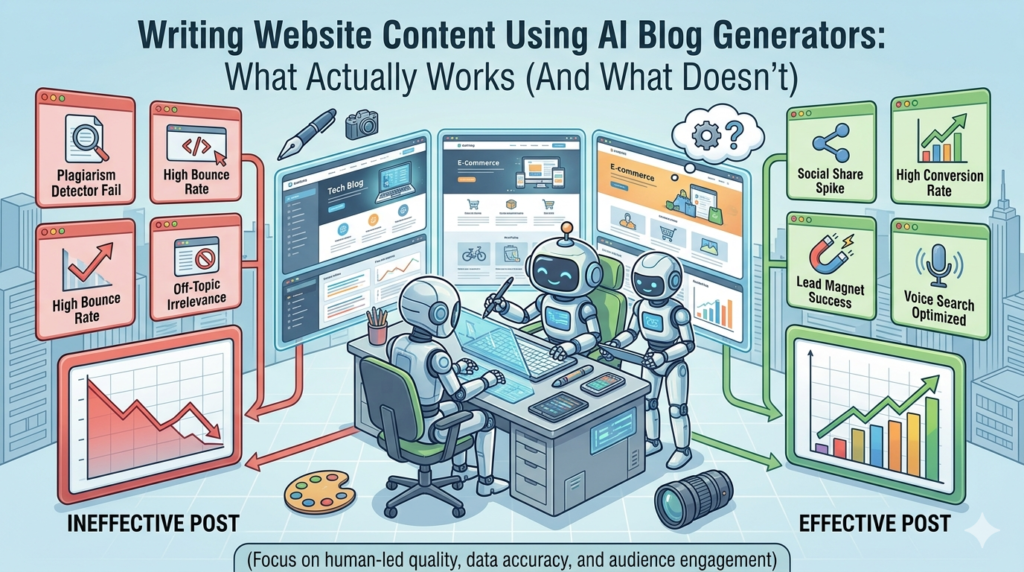
Let’s acknowledge the arc here, because it matters for understanding where we are now.
The first wave of AI writing tools — the ones that showed up around 2020 and 2021 — were capable of producing grammatically correct sentences at impressive speed, and not much more. The content was often repetitive, factually unreliable, and had a particular hollow quality that experienced readers picked up immediately, even if they couldn’t articulate exactly why.
That has changed substantially. Over 61% of marketers now use an AI content generator as part of their daily workflow, and this isn’t because the tools are merely adequate — it’s because the underlying models have matured to the point where, with the right input and editing approach, the output can be genuinely good.
Modern AI writing platforms understand context, maintain brand voice, optimize for SEO, and can generate content that reads naturally with minimal human editing when used correctly. The “when used correctly” is doing a lot of work in that sentence, which is why we’ll spend considerable time on workflow.
The useful mental shift is to stop thinking about AI blog generators as content machines and start thinking about them as capable junior writers who need good briefings, clear direction, and thorough editing before anything goes live. That reframe changes how you set up your prompts, how you evaluate the output, and how much post-generation work you build into your process.
Jasper.ai: What It Actually Does Well
Jasper is the AI writing tool that most professional content marketers encounter first, either by choosing it directly or because an employer already has an account. AI Blog Generators It’s worth understanding where it earns its reputation and where it doesn’t.
Jasper has been around since 2021, when it was still called Jarvis. It’s raised over $125 million in funding and serves more than 100,000 paying customers this isn’t a scrappy startup running on venture capital optimism. It’s an AI-powered content platform designed specifically for marketing teams, not general-purpose use, and that distinction is the key to understanding both its strengths and its pricing.
The Brand Voice Feature: Jasper’s Real Differentiator
Jasper’s brand voice feature genuinely works your content sounds like your company, not like ChatGPT. This is the single most common thing actual users cite as their reason for sticking with Jasper over cheaper alternatives, and it’s worth understanding why it matters.
When you train Jasper on your existing content existing blog posts, your About page, past campaigns, brand guidelines AI Blog Generators it builds a model of your specific tone, vocabulary, and style. From that point, outputs lean toward your voice rather than the generic, slightly corporate register that most AI writing defaults to.
For teams producing high volumes of content across multiple writers, this is genuinely valuable. Consistency across dozens of pieces, written by different people using an AI tool, is hard to achieve otherwise. Jasper makes it meaningfully easier.
The honest caveat: brand voice training takes time and multiple iterations to get right. It’s not a one-click setup. You’ll spend meaningful time in the early weeks refining the model, flagging outputs that miss the mark, and feeding it corrections. The payoff comes later, once the system has absorbed enough examples to produce reliably on-brand drafts.
Templates and Campaign Workflows
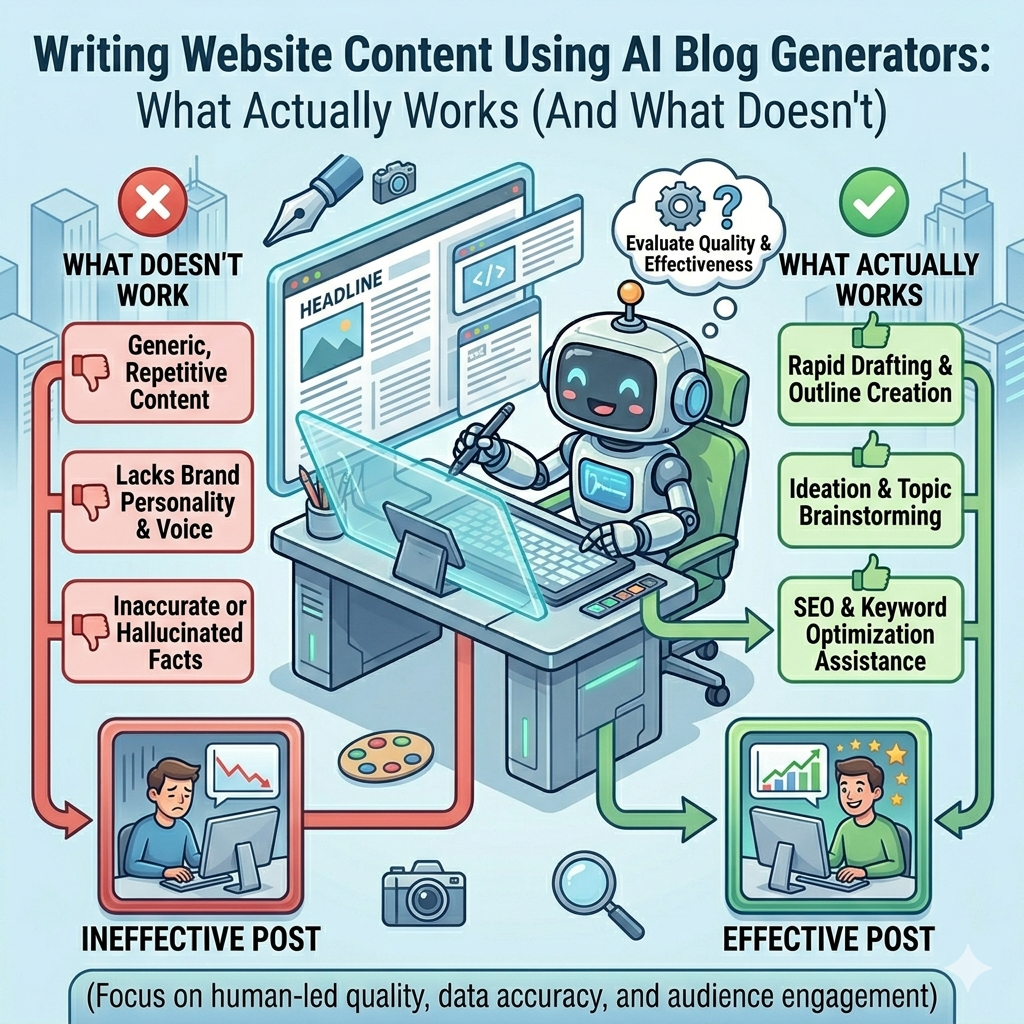
Jasper’s template library covers blog post outlines, Facebook ad copy, product descriptions, email subject lines, AIDA frameworks, and more — with the Blog Post Workflow, Content Repurposer, and PAS framework templates being among the most practically useful.
For a team producing a mix of content types — blog posts, landing pages, email campaigns, social copy — having all of these accessible within a single platform, trained on the same brand voice, genuinely reduces the friction of switching between different tools for different tasks.
Jasper now ships with 100+ specialized AI agents and Content Pipelines that automate the full content lifecycle from idea to publishing — a significant evolution from the template-only approach of earlier versions. If your operation involves high-volume content production across multiple formats and team members, this kind of end-to-end workflow support has real value.
The Pricing Reality
Here’s where the Jasper conversation gets honest.
Jasper offers three plans: Creator at $49 per month for individual users, Teams at $125 per month for up to three users, and Business with custom pricing for larger organizations. Annual billing reduces this by roughly 20%.
At $49 per month, Jasper is expensive for solo users when general-purpose tools cost much less. If you’re a freelance writer, a solo blogger, or a small business producing a modest volume of content, the math almost certainly doesn’t work in Jasper’s favor. A ChatGPT Plus subscription at $20 a month, used intelligently with good custom instructions and prompting, will get you most of the way to comparable output quality for less than half the price.
Jasper genuinely earns its premium for marketing teams producing 50 or more content pieces monthly — the brand consistency tools, collaboration features, and workflow automation add up to real time savings at that scale. For anything below that volume, the ROI calculation gets harder to justify.
AI Blog Generators Worth Knowing Beyond Jasper
The AI writing tool landscape has expanded considerably. Here are the alternatives that deserve serious consideration depending on your specific situation.
Writesonic
Writesonic has built a strong reputation for SEO-optimized blog content, and it has the advantage of offering a free plan — which Jasper does not. The SEO workflow is more tightly integrated than Jasper’s by default, making it a strong choice for content operations where search performance is the primary metric. Quality on long-form blog content is generally strong, though brand voice controls are less sophisticated than Jasper’s implementation.
Copy.ai
Better suited to short-form work than long blog posts. Copy.ai excels at social media captions, ad copy, email subject lines, and other brief formats where you need multiple variations quickly. For long-form blog content specifically, Copy.ai’s outputs tend toward lower quality compared to Jasper and more specialized tools — it’s a generalist tool that punches above its weight in short-form but shows its limits in sustained, structured long-form writing.
Surfer SEO with AI Writing
Surfer is primarily an SEO optimization tool, but its AI writing component has become increasingly capable. The distinctive advantage is that Surfer writes directly within its content editor, which simultaneously tracks target keyword usage, word count relative to competing pages, and on-page optimization signals. For teams that prioritize SEO performance, writing and optimizing in the same environment rather than generating content in one tool and optimizing in another genuinely simplifies the workflow.
ChatGPT and Claude as Writing Tools
Worth naming directly, because many content teams are using general-purpose large language models as de facto AI blog generators, often with better results than they expected.
The advantages of general-purpose models are real: lower cost, no platform lock-in, and the ability to give highly specific, nuanced instructions that purpose-built tools sometimes don’t handle as flexibly. The tradeoffs are also real: no built-in brand voice training, no content templates, no integrated SEO features, and no team collaboration layer. You’re building your own workflow rather than using someone else’s.
For technically comfortable solo creators, this approach often delivers better value. For marketing teams that need consistency across multiple users without requiring everyone to develop their own prompting skills, a purpose-built tool like Jasper is usually the more practical choice.
Quick Tool Comparison
| Tool | Best For | Free Tier | Starting Price | Standout Feature |
|---|---|---|---|---|
| Jasper.ai | Marketing teams, brand consistency | No (7-day trial) | $49/month | Best-in-class brand voice training |
| Writesonic | SEO-focused blog content | Yes | ~$16/month | Integrated SEO workflow |
| Copy.ai | Short-form, social, ad copy | Yes | ~$36/month | Speed and variation generation |
| Surfer SEO | Content optimized for search | No | ~$89/month | Write and optimize simultaneously |
| ChatGPT Plus | Flexible, general-purpose drafting | Limited | $20/month | Flexibility, cost efficiency |
How to Actually Use AI for Website Content (The Workflow That Works)
The gap between mediocre AI content and genuinely good AI-assisted content comes almost entirely down to process. Here’s the workflow that separates the two.
Step One: Write the Brief First, Not the Prompt
The most common mistake in AI content generation is treating the tool like a vending machine put a topic in, get an article out. That approach produces the hollow, forgettable content that’s currently flooding the internet.
Before you open any AI writing tool, write a clear content brief. Who is the specific audience for this piece? What do they already know, and what do they need to understand that they don’t yet? What’s the one key thing you want them to take away? What’s your perspective on this topic what do you actually think, not just what’s generically true?
The more specific and opinionated your brief, the more specific and useful the AI output will be. A prompt like “write a blog post about email marketing” produces generic content. A prompt like “write a blog post for e-commerce store owners who’ve been doing email marketing for 1-2 years but aren’t seeing the revenue numbers they expect, arguing that most email problems are actually segmentation problems rather than copy or design problems, with three practical examples” produces something worth editing.
Step Two: Use AI to Draft, Not to Decide
AI blog generators are exceptional at turning a clear outline and brief into readable prose quickly. They’re much less reliable at deciding what the article should actually argue, what examples to include, what the genuinely interesting angle is, or whether the advice is actually accurate.
Use AI for the drafting work filling in structure, generating transitions, producing multiple versions of a section so you can choose the best one, handling the formulaic parts of content like introductions and summaries. Keep the thinking, the perspective, the examples, and the editorial judgment human.
This is the human-in-the-loop model, and it’s where AI content actually works well rather than just seeming to work well on the surface.
Step Three: Fact-Check Everything, Assume Nothing
Like all AI writing tools, Jasper can generate plausible-sounding but incorrect information every piece of content still needs human fact-checking, especially for statistics, dates, and technical claims.
This is not a minor caveat. AI tools are trained to produce text that sounds confident and authoritative. They will cite statistics that don’t exist, attribute quotes to people who never said them, and describe processes that work differently in the real world than in the training data. The confidence of the output is not correlated with its accuracy.
Build fact-checking into your editing step as a non-negotiable. Verify every specific claim against a primary or reputable secondary source before publishing, not just when something seems suspicious.
Step Four: Add What Only You Can Add
The content that actually builds authority, gets linked to, and ranks durably tends to have something in it that isn’t freely available elsewhere. A genuine case study from your own experience. An insight that comes from your specific industry perspective. An opinion that your audience might not have encountered before.
AI can’t provide any of these things, because AI is drawing from what already exists. The editorial layer that transforms a competent AI draft into a piece of content worth reading is the human contribution: the story from your own experience, the data point from your own customer interviews, the take that might be slightly contrarian but is based on actual observation.
Before publishing anything generated with AI assistance, ask yourself: what’s in this piece that couldn’t have come from anywhere else? If the answer is nothing, the piece probably needs more work.
Step Five: Edit for Voice, Not Just Accuracy
After generating a draft, review AI content thoroughly, add unique insights, and refine the language to match your voice. This editing pass should cover more than fixing errors it should actively transform the AI’s default register into your specific voice.
AI writing defaults to a certain professional neutrality that’s fine but forgettable. Your editing pass is where you add the sentence that doesn’t quite follow the expected pattern. The aside that shows a bit of personality. The word choice that’s slightly unusual but exactly right. The paragraph that’s shorter than conventional wisdom suggests it should be. These are the signals that tell a reader there’s an actual person behind the content.
What AI Content Cannot Replace
A brief section on honest limitations, because the alternative is producing advice that sounds more useful than it is.
Genuine expertise cannot be fabricated. AI can produce an article that sounds expert on almost any topic. It cannot produce the insight that comes from years of doing the thing the article is about. Readers who know the field will notice the difference, and they’re usually the most valuable readers to have.
Relationships and trust take time. No amount of AI content production builds the kind of trust that comes from a track record of being right, being useful, and showing up consistently with a consistent point of view. AI can help you show up more consistently. It can’t shortcut the time required for trust to accumulate.
Search is getting smarter. Google has been explicit that it evaluates content by demonstrated expertise, authority, and trustworthiness — E-E-A-T, in the SEO shorthand. A page full of competent but empty AI content may perform adequately in the short term. Over time, the pages that accumulate links, engagement, and return visits tend to be the ones with something genuinely worth reading.
Frequently Asked Questions
Q: Is AI-generated website content bad for SEO? Not inherently Google’s guidance has consistently been that AI-generated content isn’t automatically penalized. What matters is quality, usefulness, and whether the content genuinely serves the reader. Generic, thin AI content that adds nothing new will struggle for the same reasons generic, thin human-written content struggles. Well-researched, edited AI-assisted content that provides genuine value can perform as well as anything else.
Q: Is Jasper.ai worth the cost for a solo blogger? Probably not. At $49 per month for the Creator plan, Jasper’s pricing is primarily justified by its team collaboration and brand voice features both of which are less valuable when you’re working alone and naturally writing in your own voice anyway. A general-purpose AI tool at lower cost, used with good prompting, will likely serve a solo blogger better.
Q: How do you prevent AI content from sounding generic? Three things make the biggest difference: write a highly specific brief before prompting (the more opinionated and detailed, the better); add genuine examples, opinions, or data that aren’t freely available elsewhere; and do a deliberate editing pass focused specifically on voice and personality, not just accuracy. Generic AI content is almost always the result of generic input and insufficient editing.
Q: What’s the difference between AI writing tools and just using ChatGPT? Purpose-built tools like Jasper layer marketing-specific templates, brand voice training, team collaboration features, and workflow automation on top of the underlying AI models. ChatGPT and similar general-purpose models are more flexible and usually cheaper, but require you to build your own system. The right choice depends on whether you need the structure and consistency of a dedicated tool or whether you prefer the flexibility of building your own workflow.
Q: Can AI write product descriptions and landing pages, or just blog content? All of the above, with varying degrees of success. Product descriptions tend to work well with AI, especially with good input about the product’s features and target customer. Landing pages are trickier because they need to convert, not just inform — the copy choices that drive conversions are often subtle and context-specific in ways that AI doesn’t always get right out of the box. Treat AI output for conversion-focused pages as a strong starting point that needs more editorial work than blog content.
Q: How much editing does AI-generated content actually need? Honest answer: more than most tools imply in their marketing, and less than AI skeptics suggest. A well-briefed AI draft from a good tool will typically need a thorough editing pass for accuracy, voice, and adding original perspective but it rarely needs to be rewritten from scratch. Plan for roughly 30-50% of the time of writing the piece from scratch, depending on complexity and how much original material you’re adding.
Q: Should I disclose that my content was AI-assisted? There’s no legal requirement to disclose AI assistance in general web content (as distinct from some academic and journalistic contexts where disclosure may be required). That said, some audiences respond positively to transparency about AI use in the content creation process. The more important question is whether the content meets the quality bar your audience expects — disclosure doesn’t compensate for poor quality, and good quality doesn’t require disclosure to be effective.
A Final Thought
The most useful way to think about AI blog generators Jasper, Write sonic, ChatGPT, all of them — is as capable production tools that have dramatically changed the economics of content creation, while leaving unchanged the fundamentals of what actually makes content worth reading.
Good writing has always required clear thinking, genuine expertise, a real point of view, and respect for the reader’s time. AI tools make the production of words faster and cheaper. They don’t provide the thinking, the expertise, the perspective, or the respect. Those still have to come from you.
Read more about Best AI Art