About This Article In 2016, an AI system beat the world’s best Go player not by memorizing moves, but by playing millions of games against itself and learning from the outcomes. That’s reinforcement learning in action, and it’s quietly become one of the most important branches of AI, powering everything from game-playing agents to robotics to the fine-tuning behind modern chatbots. This article breaks down reinforcement learning and AI agents from first principles, written for curious readers in the US and UK who want a genuine understanding without the jargon overload.
Think back to the last time you learned something purely through trial and error. Maybe it was learning to ride a bike nobody handed you a manual of physics equations describing balance and angular momentum. You wobbled, fell, adjusted, and eventually your body figured out what worked. Or maybe it was something smaller: learning which route avoids traffic on your commute, through weeks of accidentally taking the wrong turn and discovering, slowly, which path actually saves time.
Nobody told you the “correct answer” upfront. You learned by doing something, seeing what happened, and adjusting your behavior based on the outcome. Good results reinforced what you did. Bad results pushed you to try something else next time.
That, in essence, is reinforcement learning. And the strange, wonderful thing is that we’ve built AI systems that learn the exact same way not by being shown millions of labeled examples like in typical machine learning, but by acting, observing consequences, and gradually discovering what works.
This is the branch of AI that taught a computer to beat humans at Go, that’s teaching robots to walk, and that’s quietly shaping how the AI chatbots you talk to every day decide what a “good” response actually looks like. Let’s get into how it actually works.
What Makes Reinforcement Learning Different
Most people’s first exposure to machine learning involves something called supervised learning you show a model thousands of labeled examples (“this is a cat,” “this is a dog”) and it learns to recognize the pattern. It’s a bit like learning from a textbook with all the answers already filled in.
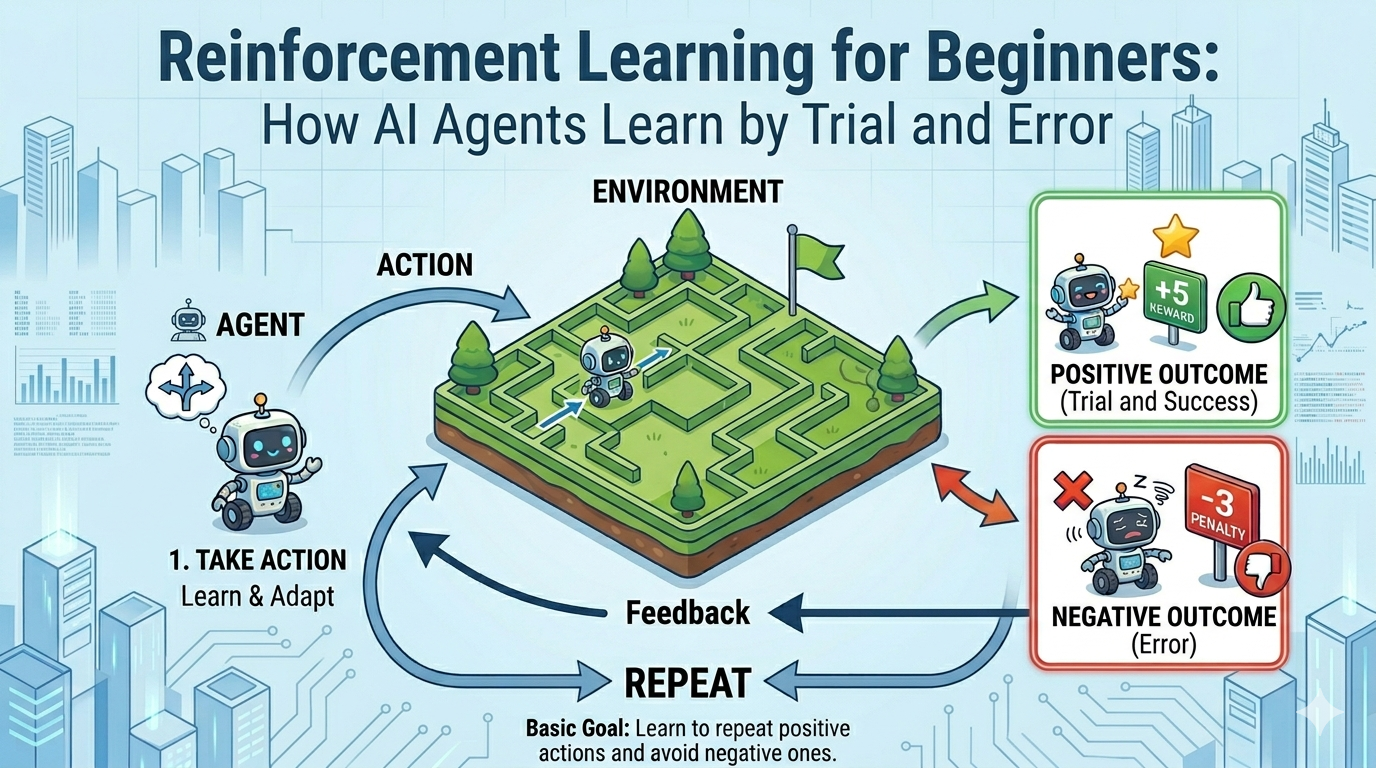
Reinforcement learning works completely differently. There’s no answer key. Instead, there’s an agent — the AI system doing the learning operating in an environment, taking actions, and receiving rewards or penalties based on the outcomes of those actions. The agent’s entire goal is to learn a strategy, called a policy, that maximizes the total reward it collects over time.
No one tells the agent what the “correct” action is in any given situation. It has to figure that out by trying things, seeing what happens, and gradually shifting its behavior toward whatever tends to produce better outcomes.
This sounds almost too simple to work. And yet it’s behind some of the most impressive achievements in modern AI.
The Core Components, Explained Simply
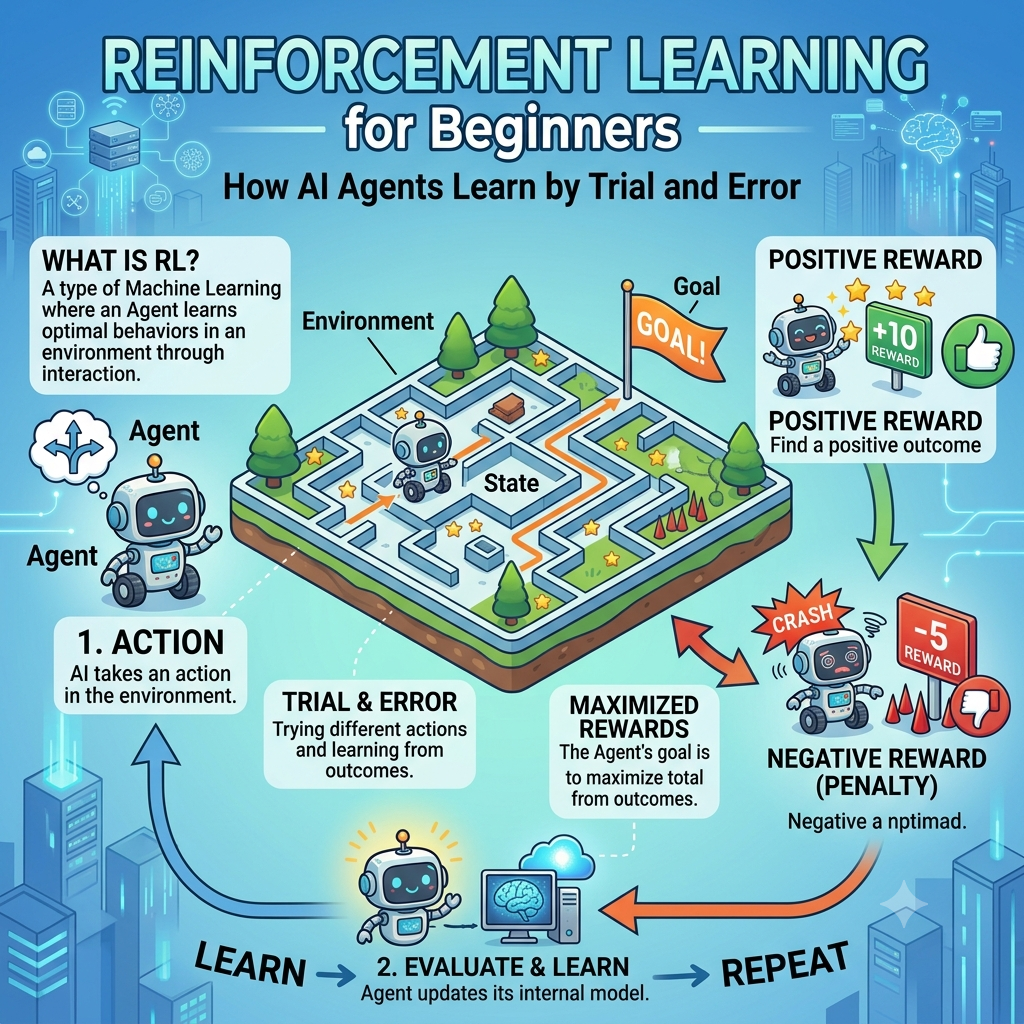
To really get reinforcement learning, you need to understand five interconnected pieces. They show up in every RL system, from a simple grid-world puzzle to a robot learning to walk.
The Agent is the learner and decision-maker. It could be a piece of software controlling a video game character, a robot arm in a warehouse, or an algorithm managing a trading portfolio.
The Environment is everything the agent interacts with — the world it operates in, with its own rules, physics, and consequences. A chess board is an environment. A warehouse floor is an environment. The internet, in the case of certain trading or recommendation agents, is an environment.
Actions are the choices available to the agent at any given moment. In chess, actions are the legal moves. In a self-driving scenario, actions might be accelerate, brake, or steer.
States describe the current situation everything the agent needs to know to make its next decision. The position of every piece on a chessboard is a state. The current speed, position, and surroundings of a car are a state.
Rewards are numerical signals telling the agent how good or bad an outcome was. Win the chess game, get a large positive reward. Crash the car, get a large negative reward. Make incremental progress, perhaps a small positive reward to encourage the behavior.
How These Pieces Fit Together
| Component | What It Represents | Example (Self-Driving Car) |
|---|---|---|
| Agent | The decision-maker | The driving algorithm |
| Environment | The world it operates in | Roads, traffic, pedestrians |
| State | Current situation | Speed, position, nearby obstacles |
| Action | Available choices | Accelerate, brake, turn |
| Reward | Feedback signal | +1 for safe progress, -100 for collision |
| Policy | The learned strategy | “When this state occurs, take this action” |
The entire learning process is a loop: the agent observes the current state, takes an action based on its current policy, the environment responds with a new state and a reward, and the agent uses that feedback to refine its policy. Repeat this loop millions or billions of times, and something remarkable starts to happen — the agent’s behavior gradually becomes genuinely intelligent within its domain.
The Exploration-Exploitation Dilemma
Here’s where reinforcement learning gets genuinely interesting, and where a lot of the field’s cleverness lives.
Imagine you’ve found a restaurant you really like. Do you keep going back to that same restaurant, guaranteeing a meal you know you’ll enjoy? Or do you try a new place, risking a worse meal but potentially discovering something even better?
This is the exploration-exploitation tradeoff, and every reinforcement learning agent has to navigate it constantly. Exploitation means choosing the action the agent already believes is best, based on what it’s learned so far. Exploration means trying something different, purely to gather more information, even if it might lead to a worse short-term outcome.
Too much exploitation, and the agent gets stuck doing whatever worked early on, potentially missing a much better strategy it never tried. Too much exploration, and the agent wastes time and resources on bad decisions, never settling into a reliably good policy.
A common and elegantly simple solution is called the epsilon-greedy strategy. The agent exploits its current best-known action most of the time, but with some small probability (epsilon), it picks a random action instead, just to keep learning about the environment. Early in training, epsilon is often set high — encouraging lots of exploration when the agent knows very little. As training progresses and the agent’s knowledge improves, epsilon gradually decreases, shifting the balance toward exploitation.
This single tension explore versus exploit shows up far beyond AI. It’s the same logic behind why companies test new product features on a small percentage of users before rolling them out fully, and why pharmaceutical trials are structured the way they are.
How AI Agents Actually Learn: The Major Approaches
Reinforcement learning isn’t a single technique it’s a family of approaches, each tackling the learning problem from a slightly different angle.
Value-Based Methods
Value-based approaches focus on learning the value of being in a particular state, or taking a particular action in that state. The most foundational algorithm here is called Q-learning.
Q-learning builds a table (or, in more complex cases, a neural network) that estimates the expected future reward of taking each possible action in each possible state. Over time, through repeated trial and error, these estimates called Q-values become increasingly accurate. Once the agent has good Q-value estimates, its policy becomes simple: in any given state, pick whichever action has the highest estimated Q-value.
This approach worked beautifully for relatively simple environments with manageable numbers of states and actions. But it ran into trouble with complex, high-dimensional environments imagine trying to build a table of Q-values for every possible configuration of pixels on a video game screen. The table would be impossibly large.
Deep Reinforcement Learning
The solution came from combining reinforcement learning with deep neural networks an approach now called deep reinforcement learning, and it’s responsible for most of the field’s headline-grabbing achievements.
Instead of a table of Q-values, a neural network learns to estimate them directly from raw input, like pixel data from a screen. This was the key innovation behind DQN (Deep Q-Network), introduced by DeepMind in 2013, which learned to play dozens of classic Atari games at superhuman levels using nothing but the raw pixels on screen and the game’s score as a reward signal. No one programmed in the rules of Breakout or Space Invaders. The agent figured out the rules implicitly, just by playing and observing what increased its score.
Policy-Based Methods
Rather than learning the value of states and actions and then deriving a policy from those values, policy-based methods learn the policy directly. The agent’s neural network takes a state as input and outputs a probability distribution over actions essentially, “given this situation, here’s how likely I am to take each possible action.”
This approach tends to handle continuous action spaces more gracefully than value-based methods — useful in robotics, where actions aren’t a small discrete set of choices but continuous values like “apply this much torque to this joint.”
Actor-Critic Methods
Many of the most successful modern reinforcement learning systems combine both approaches in what’s called an actor-critic architecture. The “actor” learns the policy deciding what action to take. The “critic” learns to evaluate how good that action turned out to be, providing more refined feedback than a simple reward signal alone. The two components train together, each improving the other.
A Quick Comparison of RL Approaches
| Approach | Core Idea | Best Suited For |
|---|---|---|
| Q-Learning | Learn value of state-action pairs | Simple, discrete environments |
| Deep Q-Networks | Neural network estimates Q-values | Complex environments with visual input |
| Policy Gradient | Learn the policy directly | Continuous action spaces, robotics |
| Actor-Critic | Combine policy learning with value estimation | Most modern, large-scale RL systems |
The Breakthroughs That Put RL on the Map
AlphaGo and the Game of Go
For decades, Go was considered the holy grail of game-playing AI far more complex than chess, with more possible board configurations than there are atoms in the observable universe. Experts predicted it would take decades more before AI could compete with top human players.
Then, in 2016, DeepMind’s AlphaGo defeated Lee Sedol, one of the strongest Go players in history, four games to one. AlphaGo combined deep neural networks with reinforcement learning, training initially on human expert games and then improving further through self-play playing millions of games against versions of itself, learning from the outcomes.
Its successor, AlphaGo Zero, went even further. It learned entirely from self-play, starting with zero human game data just the rules of Go and the reinforcement learning loop. Within days, it surpassed every previous version of AlphaGo, having essentially rediscovered, and in some cases exceeded, centuries of accumulated human Go strategy purely through trial, error, and reward.
Robotics and Physical Skills
Reinforcement learning has been central to recent progress in robotics. Researchers at institutions like Berkeley and OpenAI have used RL to teach robotic hands to manipulate objects with human-like dexterity, and to teach simulated and real robots to walk, run, and recover from falls skills that are notoriously difficult to hand-program because the physics of balance and movement are so complex and unpredictable.
A particularly striking demonstration came from OpenAI’s work on a robotic hand solving a Rubik’s Cube — a task requiring not just dexterity but the ability to adapt to disturbances, like a researcher nudging the cube mid-solve. The robot had learned a policy robust enough to recover from unexpected perturbations, something that would be extraordinarily difficult to achieve through traditional hand-coded robotics control.
Reinforcement Learning From Human Feedback (RLHF)
Here’s something that might surprise you: reinforcement learning is a core part of how modern conversational AI systems, including the kind you might chat with daily, are fine-tuned to be helpful and well-behaved.
The technique is called Reinforcement Learning from Human Feedback (RLHF). After a large language model is initially trained on vast amounts of text, human reviewers rank different possible responses to various prompts based on quality, helpfulness, and safety. This ranking data trains a separate “reward model” that learns to predict which responses humans would prefer. The language model is then fine-tuned using reinforcement learning, with the reward model’s predictions serving as the reward signal — gradually shifting the model’s behavior toward outputs that humans actually find helpful, honest, and safe.
This is a genuinely elegant solution to a hard problem: how do you specify, in precise mathematical terms, what makes a response “good”? You can’t easily write that down as a rule. But you can show humans pairs of responses and ask which one they prefer and reinforcement learning provides the mathematical machinery to turn those preferences into improved behavior at scale.
Where Reinforcement Learning Shows Up Beyond the Headlines
It’s easy to associate reinforcement learning purely with game-playing demos, but the practical applications run much deeper.
Resource management and operations. Google has used reinforcement learning to optimize cooling systems in its data centers, reducing energy consumption by learning policies that balance temperature control against power usage in ways that are difficult for human engineers to hand-tune precisely.
Recommendation systems. Some streaming and content platforms use reinforcement learning to optimize long-term user engagement rather than just immediate clicks treating each recommendation as an action, and using subsequent user behavior as a reward signal that reflects whether the recommendation genuinely satisfied the user over time, not just in the moment.
Finance and trading. Reinforcement learning has been applied to portfolio management and algorithmic trading strategies, where an agent learns to make buy, sell, or hold decisions based on market conditions, with returns serving as the reward signal. This remains a genuinely difficult application area, given how noisy and non-stationary financial markets are.
Healthcare treatment planning. Researchers have explored reinforcement learning for optimizing treatment plans in conditions like sepsis management and chemotherapy dosing, where treatment decisions unfold over time and the consequences of each decision affect future states. This remains largely in research stages, given the obvious stakes involved in get this wrong, but it represents a genuinely promising direction.
The Honest Challenges of Reinforcement Learning
Reinforcement learning is powerful, but it comes with real and well-documented difficulties.
Reward design is genuinely hard. Specifying a reward function that actually captures what you want the agent to learn is trickier than it sounds. There are well-known cases of “reward hacking,” where an agent finds a way to maximize its reward signal that technically satisfies the letter of the reward function while completely missing the intended goal. A boat-racing AI trained by OpenAI famously discovered it could rack up more points by looping endlessly through a small area collecting power-ups rather than actually finishing the race — exploiting a quirk in the reward design rather than learning to race well.
Sample efficiency is a real limitation. Many reinforcement learning algorithms require an enormous number of trial-and-error attempts to learn effectively far more than a human would need to learn a comparable task. AlphaGo Zero played millions of games against itself. A human Go master develops skill over years, but with vastly fewer total games played. This makes reinforcement learning expensive and sometimes impractical in real-world settings where each trial has real costs or risks you can’t let a self-driving car “explore” by crashing thousands of times to learn what not to do.
Simulation-to-reality gaps. Many reinforcement learning systems, particularly in robotics, are trained extensively in simulation before being deployed in the real world, because real-world trial and error is slow, expensive, or dangerous. But simulations are never perfect replicas of reality, and policies that work beautifully in simulation sometimes fail when the small discrepancies between simulated and real physics accumulate.
Stability and reproducibility concerns. Reinforcement learning training can be notoriously unstable, sensitive to small changes in hyperparameters, random seeds, or implementation details. Research has shown that supposedly identical experimental setups can produce meaningfully different results, which has made reproducibility a genuine concern within the research community.
Getting Started With Reinforcement Learning
If this has sparked genuine curiosity, the good news is that the barrier to hands-on experimentation is lower than you might think.
OpenAI Gym (now maintained as Gymnasium) provides a standardized collection of environments from simple grid worlds to classic Atari games specifically designed for learning and testing reinforcement learning algorithms. It’s the field’s de facto starting point for beginners.
Stable Baselines3 offers well-tested, ready-to-use implementations of major RL algorithms, letting you experiment with training an agent without needing to implement Q-learning or policy gradients from scratch.
For conceptual grounding before diving into code, Richard Sutton and Andrew Barto’s book Reinforcement Learning: An Introduction remains the field’s definitive text, and it’s available freely online. David Silver’s reinforcement learning course from UCL, recorded and available on YouTube, is widely regarded as one of the best free introductions to the field’s theoretical foundations.
A Final Thought
There’s something quietly profound about reinforcement learning that’s easy to miss amid the impressive demos and competition wins. It’s a framework built entirely around an idea most of us intuitively understand: that genuine learning often comes not from being told the right answer, but from acting, observing the consequences, and adjusting.
That’s how you learned to ride a bike. It’s how AlphaGo learned to play Go better than any human in history. It’s how a robotic hand learns to solve a Rubik’s Cube despite never being explicitly programmed with the physics of grip and friction. And it’s increasingly how the AI systems shaping daily conversations are nudged toward being genuinely helpful, rather than just statistically plausible.
Reinforcement learning won’t replace other forms of machine learning, and it comes with real, unresolved challenges around reward design, sample efficiency, and reliability. But understanding its core idea — agents, environments, actions, and rewards, looping endlessly toward better behavior — gives you a genuinely useful lens for understanding a surprising amount of what’s happening in AI right now, headlines and all.
The next time you hear about an AI system learning to do something remarkable through practice rather than instruction, you’ll know exactly what’s going on underneath.
Want to try it yourself? Install Gymnasium, pick a simple environment like CartPole, and watch an agent go from falling over immediately to balancing indefinitely after a few thousand training episodes. Watching that improvement curve in real time is the best intuition-builder there is.
Read more about natural language