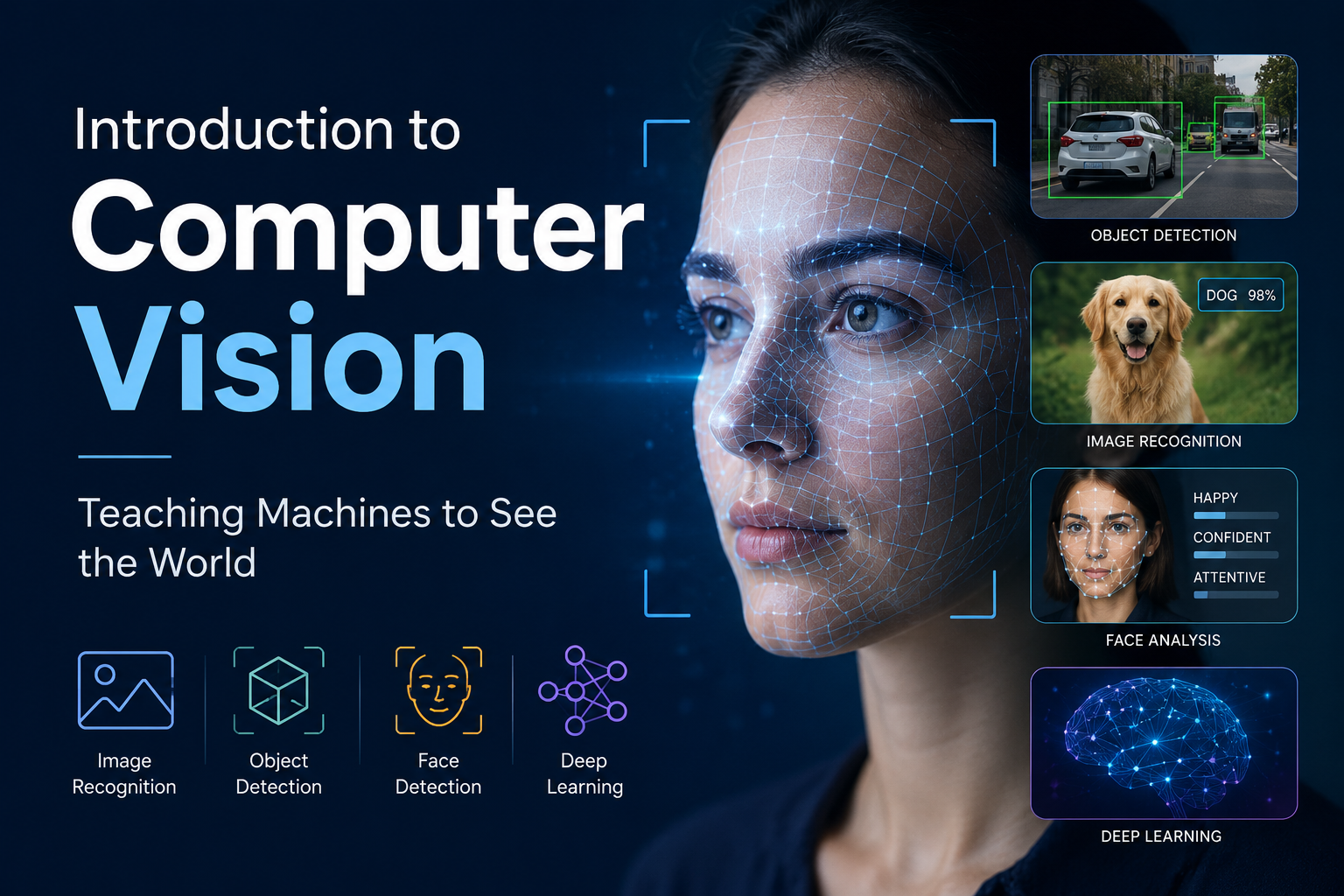
Close your eyes for a second and think about what just happened when you read that sentence. You didn’t just see shapes on a screen. You recognized letters, grouped them into words, understood meaning, and probably pictured something —maybe literally closing your eyes, maybe not. Your brain did this in a fraction of a second, without any conscious effort, the same way it effortlessly recognizes a friend’s face in a crowded train station or notices a dog has wandered into the road ahead.
Now consider this: a computer looking at that same train station sees nothing but a grid of numbers. Red, green, blue values, pixel by pixel. No concept of “friend.” No concept of “face” or “platform” or “danger.” Just numbers.
Getting a machine from “grid of numbers” to “that’s my friend waving” is one of the most difficult problems in artificial intelligence and also one of the most solved. Not perfectly. Not universally. But solved well enough that computer vision now quietly runs in the background of an enormous number of things we touch every day.
This article is about how that happened, what’s actually going on under the hood, and where the technology genuinely shines versus where it still stumbles.
What Computer Vision Actually Is
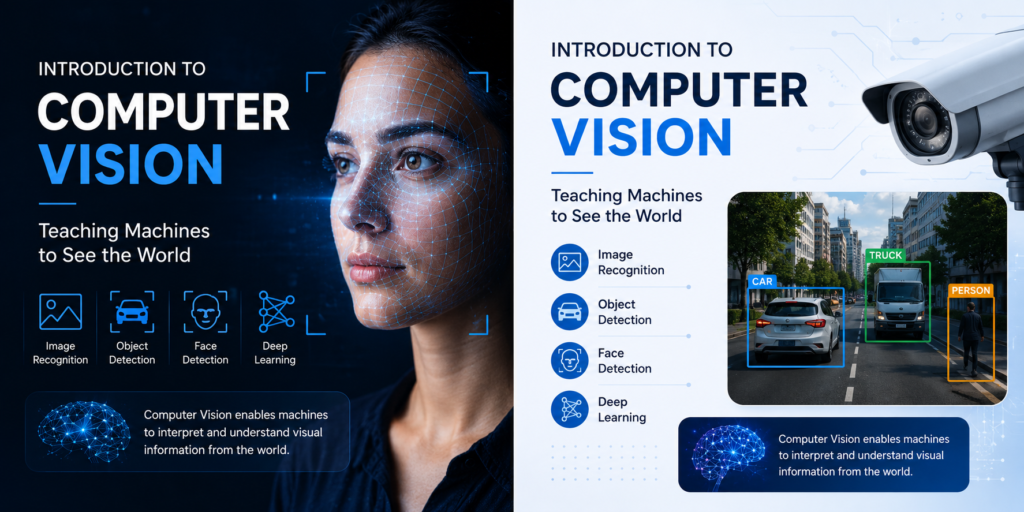
Computer vision is the field of artificial intelligence focused on enabling machines to interpret and understand visual information from the world photos, video, live camera feeds the same way humans use their eyes and brains to make sense of what they see.
That’s the textbook definition. Here’s the more useful one: computer vision is the art of converting pixels into decisions.
A security camera doesn’t care about pixels for their own sake. It cares whether there’s an intruder. A medical imaging system doesn’t care about the grayscale values in an MRI scan. It cares whether there’s a tumor. A self-driving car doesn’t care about the colors on the road ahead. It cares whether that shape is a pedestrian, a plastic bag, or a parked car.
The entire discipline exists to bridge the gap between raw visual data and meaningful understanding. And that gap, it turns out, is enormous.
Why Vision Is Deceptively Hard
Here’s something that trips people up: image recognition AI feels like it should be easier than language understanding, because images seem more “objective” than words. A photo of a cat is a photo of a cat — no ambiguity, no sarcasm, no double meanings.
Except that’s not actually true once you look closely.
A cat photographed from above looks completely different from a cat photographed from the side. A cat in shadow looks different from a cat in bright sunlight. A cat that’s mostly hidden behind a sofa looks different from a cat sitting in the open. A drawing of a cat, a cat-shaped cookie, and a cat costume on a dog all present completely different pixel patterns yet a five-year-old child instantly understands what’s going on in each case.
Humans solve this through years of embodied experience and a staggering amount of contextual knowledge. Machines had to be taught this from scratch, mathematically, using nothing but examples and statistics. That’s the entire story of computer vision’s development: finding increasingly clever ways to extract stable, meaningful patterns from wildly variable pixel data.
How Image Recognition AI Actually Works
Let’s open the hood and look at what’s actually happening when a computer “recognizes” an image.
Step One: An Image Is Just Numbers
Every digital image is a grid of pixels, and every pixel is a set of numbers representing color intensity — typically a red, green, and blue value, each ranging from 0 to 255. A modest 1,000 by 1,000 pixel photo contains a million individual pixels, each with three numbers attached. That’s three million numbers describing a single image.
This is the raw material computer vision systems work with. No labels, no context, no inherent meaning. Just a massive grid of numbers that happens to correlate, in some complex statistical way, with the presence of a cat, a stop sign, or a tumor.
Step Two: Extracting Features
The earliest computer vision systems, dating back to the 1960s and 70s, tried to hand-design rules for recognizing features. Edge detection algorithms looked for sudden changes in pixel brightness the boundary between a dark object and a light background, for instance. Corner detection algorithms looked for points where edges met at sharp angles.
These hand-crafted feature detectors worked reasonably well for narrow, controlled tasks reading handwritten postal codes, for example, where the variation was limited and predictable. But they fell apart quickly when faced with the genuine messiness of real-world images: varying lighting, angles, occlusion, and the sheer diversity of how objects can appear.
Step Three: Convolutional Neural Networks Change the Game
The real breakthrough came with Convolutional Neural Networks (CNNs) a type of deep learning architecture specifically designed for processing grid-like data such as images.
Here’s the intuition. A CNN applies small filters across an image, each filter scanning for a specific simple pattern — a vertical edge, a patch of a particular color, a curve. The output of this first layer is a map showing where those simple patterns occur across the image.
The next layer takes those simple pattern maps and combines them into slightly more complex patterns. Two edges meeting at an angle might indicate a corner. A curve combined with another curve might indicate a circular shape. Layer by layer, the network builds increasingly abstract and sophisticated representations — from edges, to shapes, to textures, to object parts, to full objects.
By the time you reach the final layers of a well-trained CNN, the network has effectively learned to ask, “Does this combination of shapes, textures, and patterns add up to a dog, a stop sign, or a tumor?”
This hierarchical, layered approach to feature extraction is what makes CNNs so much more powerful than hand-crafted rules. The network learns the relevant features directly from data, rather than relying on a human to guess which features matter.
The 2012 Moment That Changed Everything
If you want a single moment that marks computer vision’s turning point, it’s 2012.
That year, a deep CNN called AlexNet entered the ImageNet Large Scale Visual Recognition Challenge — an annual competition where systems are tested on their ability to correctly classify images across a thousand different categories. The best systems before 2012 had error rates hovering around 26%. AlexNet achieved 15.3%.
That gap doesn’t sound dramatic until you understand what it represented: deep learning-based computer vision had just decisively outperformed every other approach researchers had tried for decades. Within a few years, virtually every serious computer vision system in both academia and industry had shifted to deep learning. The error rates kept falling by 2015, some systems were matching or exceeding human-level accuracy on the same benchmark.
Quick Reference: How a CNN Processes an Image
| Stage | What Happens | Real-World Analogy |
|---|---|---|
| Input | Raw pixel grid fed into the network | Light hitting the retina |
| Early Layers | Detect edges, colors, simple textures | Recognizing basic shapes and contrast |
| Middle Layers | Combine simple features into parts | Recognizing an eye, an ear, a wheel |
| Deep Layers | Combine parts into whole objects | Recognizing a face, a car, a tumor |
| Output | Final classification or detection | “This is a cat, 94% confidence” |
The Many Faces of Computer Vision
“Computer vision” sounds like one technology, but it’s really an umbrella covering several distinct tasks, each with its own challenges and applications.
Image Classification
The simplest task: given an image, assign it a single label. Is this a photo of a dog or a cat? Is this X-ray showing pneumonia or not? Image classification was the task that AlexNet tackled, and it remains foundational to the field.
Object Detection
A step beyond classification object detection identifies not just what’s in an image, but where. Instead of a single label, the output is a set of bounding boxes, each surrounding a detected object with an associated label. This is the technology behind a self-driving car identifying every pedestrian, vehicle, and traffic sign in its field of view simultaneously.
Semantic Segmentation
An even more granular task. Instead of drawing a box around an object, semantic segmentation classifies every single pixel in the image according to what object it belongs to. This produces a detailed map every pixel of road colored one way, every pixel of sky another, every pixel of pedestrian another still. Medical imaging relies heavily on this technique to precisely outline the boundaries of a tumor or organ.
Facial Recognition
A specialized application that identifies or verifies a person’s identity from their facial features. It typically works by extracting a numerical “faceprint” a vector that captures the distinctive geometry of someone’s face and comparing it against stored faceprints to find a match. This is what’s happening when your phone unlocks by looking at you, or when an airport’s automated passport control compares your face to your passport photo.
Pose Estimation
This task identifies the position and orientation of a person’s body locating joints like elbows, knees, and shoulders within an image or video. It’s the technology behind fitness apps that correct your exercise form, motion capture for film and video games, and some sports analytics platforms that track athlete movement frame by frame.
Optical Character Recognition (OCR)
One of the oldest and most mature computer vision applications: converting images of text into machine-readable text. Scanning a document, photographing a receipt, or using your phone’s camera to translate a foreign menu all rely on OCR.
Comparing the Core Computer Vision Tasks
| Task | What It Outputs | Example Application |
|---|---|---|
| Image Classification | A single label for the whole image | Sorting photos by content |
| Object Detection | Bounding boxes with labels | Self-driving car perception |
| Semantic Segmentation | Pixel-level object classification | Medical tumor boundary mapping |
| Facial Recognition | A matched identity | Phone unlock, passport control |
| Pose Estimation | Body joint coordinates | Fitness form correction, motion capture |
| OCR | Extracted text | Document scanning, translation apps |
Where Computer Vision Is Already Changing Things
This isn’t speculative future technology. Computer vision is operating, right now, in ways that have real consequences across major industries.
Healthcare
Computer vision systems trained on medical imaging are matching or exceeding specialist-level accuracy on specific diagnostic tasks. Diabetic retinopathy screening, certain types of skin cancer detection, and identification of lung nodules in CT scans are areas where deep learning-based image recognition has demonstrated genuinely strong clinical results. The technology doesn’t replace radiologists or dermatologists it acts as a second set of eyes, catching things that might otherwise be missed, especially in settings where specialist access is limited.
Automotive and Transportation
Self-driving and driver-assistance systems depend almost entirely on computer vision to interpret the world. Cameras (often combined with radar and lidar) feed continuous visual data into object detection systems that identify lanes, vehicles, pedestrians, cyclists, and traffic signals in real time. The challenge isn’t just recognizing these things in good conditions it’s doing so reliably in rain, fog, glare, and the countless unpredictable scenarios real roads present.
Retail and E-Commerce
Visual search taking a photo of a product and finding where to buy it runs on computer vision matching the photographed item against a database of product images. Inventory management systems use computer vision to monitor shelf stock automatically. Some physical retail stores have experimented with checkout-free shopping, where cameras and computer vision track what shoppers pick up and charge them automatically on exit.
Agriculture
Computer vision is quietly transforming farming. Drones equipped with cameras and image recognition AI can survey crop fields, detect early signs of disease or pest infestation, and assess plant health at a scale no human inspection team could match. Automated harvesting systems use computer vision to identify ripe produce and guide robotic picking arms.
Manufacturing and Quality Control
On production lines, computer vision systems inspect products at speeds and consistency levels humans simply can’t sustain. A camera can scan thousands of items per minute, flagging defects in surface finish, alignment, or assembly that would be exhausting and error-prone for a human inspector to catch reliably over an eight-hour shift.
Security and Surveillance
Facial recognition, anomaly detection, and behavior analysis are increasingly embedded in security systems from airport screening to retail loss prevention. This is also the application area that draws the most public scrutiny, and for good reason, which we’ll get to shortly.
The Honest Limitations of Computer Vision
It would be irresponsible to write about this technology without being upfront about where it struggles — because the gaps matter, sometimes a great deal.
Bias in training data produces biased outcomes. Facial recognition systems have been documented, in multiple independent studies, to perform less accurately on darker-skinned faces and on women compared to lighter-skinned male faces. This isn’t a mysterious flaw in the algorithms themselves it’s a direct consequence of training datasets that historically over-represented certain demographics. The fix requires deliberately diversifying training data, not just tweaking model architecture.
Adversarial vulnerabilities are real. Researchers have shown that tiny, often imperceptible changes to an image a few strategically altered pixels, a small sticker placed on a stop sign can cause computer vision systems to misclassify objects with high confidence. This has serious implications for security-critical applications like autonomous vehicles and access control systems.
Context and common sense remain elusive. A computer vision system can identify “a person” and “a knife” in an image without understanding whether that combination represents a chef in a kitchen or a dangerous situation. Connecting visual recognition to genuine situational understanding remains a significant unsolved challenge.
Performance degrades outside training conditions. A system trained primarily on well-lit, high-resolution images can perform dramatically worse on grainy security footage, unusual camera angles, or environmental conditions like fog and heavy rain. This gap between lab performance and real-world reliability is one of the most persistent practical challenges in deploying computer vision systems.
Privacy concerns are not hypothetical. Widespread deployment of facial recognition and surveillance-oriented computer vision raises legitimate questions about consent, data retention, and the potential for mass tracking of individuals without their knowledge. Several cities and jurisdictions in the US and UK have already restricted or banned certain facial recognition use cases in response to these concerns a sign that the technology’s capability has outpaced society’s settled answers about how it should be governed.
What’s Coming Next in Computer Vision
A few directions worth keeping an eye on:
Vision-language models are merging computer vision with natural language processing, allowing systems to not just recognize objects in an image but describe scenes, answer questions about images, and reason about visual content in ways that resemble genuine comprehension. Models like GPT-4o and Google’s Gemini represent significant steps in this direction.
Synthetic training data is becoming increasingly important as a way to address bias and data scarcity. Instead of relying solely on real-world photographs, researchers are generating realistic synthetic images computer-generated scenes with known, controllable properties to train systems more fairly and efficiently, particularly for rare scenarios that are hard to capture naturally.
Edge computing for vision is pushing computer vision processing directly onto devices phones, cameras, drones rather than relying on cloud servers. This reduces latency, improves privacy (since images don’t need to leave the device), and enables real-time applications in places with limited connectivity.
3D and spatial understanding is moving beyond flat image analysis toward genuine three-dimensional scene reconstruction, which is critical for robotics, augmented reality, and more sophisticated autonomous navigation.
Frequently Asked Questions
Q: What’s the difference between computer vision and image recognition? Image recognition is a specific task within the broader field of computer vision it refers to identifying what’s present in an image (classification) or recognizing specific objects, faces, or text. Computer vision is the umbrella discipline that includes image recognition along with object detection, segmentation, pose estimation, and other visual interpretation tasks. Think of image recognition as one tool in computer vision’s much larger toolbox.
Q: How accurate is modern computer vision compared to human vision? On narrow, well-defined tasks with good training data classifying specific objects, detecting certain medical conditions, reading text modern systems can match or exceed human accuracy. But human vision remains far more flexible and robust across the enormous variety of real-world conditions, ambiguous situations, and contextual reasoning that we navigate effortlessly. Computer vision excels at narrow, well-specified problems; humans still win decisively at general-purpose visual understanding.
Q: Do I need to know how to code to understand computer vision? Not to understand the concepts the core ideas (pixels as numbers, feature extraction, layered pattern recognition) are explainable without code. If you want to build computer vision systems yourself, Python is the standard language, paired with libraries like OpenCV for classical techniques and Porch or Tensor Flow for deep learning approaches.
Q: Why do self-driving cars still struggle with certain situations if computer vision is so advanced? Self-driving systems need near-perfect reliability across an almost infinite range of real-world scenarios — unusual lighting, unexpected obstacles, ambiguous human behavior, and edge cases that simply weren’t well-represented in training data. The technology has improved dramatically, but the gap between “very good most of the time” and “safe enough for unsupervised public roads” is enormous, which is why fully autonomous driving has taken longer to deploy widely than early predictions suggested.
Q: Is facial recognition technology regulated in the US and UK? Regulation is evolving and varies significantly by jurisdiction. Several US cities and states have passed restrictions on government use of facial recognition, particularly by law enforcement. The UK operates under data protection frameworks that govern biometric data use, with ongoing legal and public debate about appropriate limits, particularly around live facial recognition in public spaces. This is an active and unsettled area of policy in both countries.
Q: What’s a good starting point if I want to learn computer vision hands-on? OpenCV’s official tutorials are an excellent starting point for classical computer vision techniques. For deep learning-based approaches, PyTorch’s official vision tutorials and the freely available Stanford CS231n course materials (Convolutional Neural Networks for Visual Recognition) offer a strong combination of theoretical grounding and practical implementation experience.
A Final Thought
There’s something genuinely remarkable about the fact that machines can now look at a photograph and tell you, with real accuracy, what’s in it. Not because they see the way we do they don’t, not really but because decades of mathematical insight, computational power, and enormous amounts of data have combined to produce something that functions, in narrow but meaningful ways, like sight.
Computer vision isn’t magic, and it isn’t infallible. It inherits the biases of the data it learns from, struggles with situations its training never anticipated, and raises real questions about privacy and surveillance that society hasn’t fully answered. But dismissing it as a passing trend would be just as much a mistake as treating it as flawless.
The technology is already woven into healthcare, transportation, retail, and security in ways most people never notice. Understanding how it actually works pixels into patterns, patterns into objects, objects into decisions gives you something valuable: the ability to engage with this technology critically, rather than either fearing it blindly or trusting it uncritically.
That balance, more than any specific technical fact, is the most useful thing to take away.
Curious to see it in action? Try Google’s Teachable Machine you can train a simple image recognition model in your browser, with your own webcam, in under five minutes. There’s no better way to understand computer vision than watching it learn in real time.
Read more about Neural Networks
FAQ
Q: What’s the difference between computer vision and image recognition?
Image recognition is a specific task within the broader field of computer vision — it refers to identifying what’s present in an image (classification) or recognizing specific objects, faces, or text. Computer vision is the umbrella discipline that includes image recognition along with object detection, segmentation, pose estimation, and other visual interpretation tasks. Think of image recognition as one tool in computer vision’s much larger toolbox.
Q: How accurate is modern computer vision compared to human vision?
On narrow, well-defined tasks with good training data — classifying specific objects, detecting certain medical conditions, reading text — modern systems can match or exceed human accuracy. But human vision remains far more flexible and robust across the enormous variety of real-world conditions, ambiguous situations, and contextual reasoning that we navigate effortlessly. Computer vision excels at narrow, well-specified problems; humans still win decisively at general-purpose visual understanding.
Q: Is computer vision the same thing as AI, or is it a separate field?
Computer vision is a subfield of artificial intelligence, not a separate discipline. AI is the broad umbrella covering any system that exhibits intelligent behavior — reasoning, learning, perception, language. Computer vision focuses specifically on the perception of visual information, and increasingly overlaps with deep learning and natural language processing in modern systems that combine visual and linguistic understanding.
How It Works
Q: How does a computer actually “see” an image?
It doesn’t see in any sense resembling human vision. A digital image is stored as a grid of numbers — typically red, green, and blue intensity values for each pixel. A computer vision model processes that grid through layers of mathematical operations, gradually transforming raw pixel values into increasingly abstract representations: edges, then shapes, then object parts, then whole objects.
Q: What is a Convolutional Neural Network, and why is it central to computer vision?
A Convolutional Neural Network (CNN) is a deep learning architecture designed for grid-structured data like images. It slides small filters across an image to detect localized patterns — edges, textures, gradients — then combines those patterns in successive layers to recognize increasingly complex features. CNNs became dominant after 2012 because they dramatically outperformed earlier hand-crafted feature detection methods.
Q: What’s the difference between object detection and image classification?
Image classification assigns a single label to an entire image — “this is a dog.” Object detection goes further, identifying multiple objects within one image and drawing a bounding box around each, with its own label. Detection tells you not just what’s present, but where.
Real-World Applications
Q: How reliable is computer vision in medical diagnosis?
In specific, well-defined tasks — like detecting diabetic retinopathy or certain skin cancers — peer-reviewed studies show computer vision performing at or above specialist-level accuracy. Reliability depends heavily on training data quality and diversity, which is why these systems are typically deployed as diagnostic aids rather than replacements for clinical judgment.
Read more about Neural Networks