Think about the last time you typed a question into Google and got exactly what you were looking for — not a list of pages containing your keywords, but an actual answer. Or the last time your email client correctly sorted a newsletter into your promotions folder, almost like it read the thing. Or the moment a customer service chatbot surprised you by actually understanding what you meant, even though you phrased it badly.
None of that happened by accident. And none of it happened because computers suddenly became smart.
It happened because of decades of work in a field called Natural Language Processing — the branch of artificial intelligence concerned with teaching machines to read, interpret, and generate human language. NLP is, in many ways, the hardest problem in AI. Language is ambiguous, contextual, culturally loaded, and constantly evolving. The word “bank” means something different depending on whether you’re fishing or filing taxes. Sarcasm looks identical to sincerity on the page. “I saw the man with the telescope” has two entirely valid interpretations.
Humans navigate all of this effortlessly. Machines had to be taught — painstakingly, mathematically — to do the same.
Here’s how.
Why Language Is So Hard for Computers
Before getting into the solutions, it’s worth sitting with the problem for a moment. Because the difficulty of NLP isn’t immediately obvious until you start thinking carefully about what language actually does.
Consider a simple sentence: “The trophy didn’t fit in the suitcase because it was too big.”
What does “it” refer to? You know immediately the trophy. But how? There’s nothing in the grammar that tells you. You inferred it from common sense: suitcases don’t usually have to fit into things. That inference requires knowledge about the physical world, object sizes, and the logic of containment. Knowledge a child develops over years of embodied experience in the world.
Now consider sarcasm: “Oh great, another Monday.” On the surface, that’s a positive statement. In context, it almost never is. Detecting that requires understanding tone, cultural attitudes toward the start of the work week, and the social function of ironic complaints.
Or ambiguity: “I’m reading a book on AI.” Are you reading a physical book that happens to be about AI? Or are you reading a digital resource accessed through an AI system? Context resolves it instantly for humans. For early text processing systems, it was a genuine problem.
These aren’t edge cases. They’re the everyday texture of human language. NLP is the project of building systems that handle them gracefully.
The Basics of Text Processing: Turning Words into Numbers
Computers don’t read. They compute. So the first challenge of NLP is fundamentally a translation problem: how do you convert language into something a machine can actually work with?
Tokenization: Breaking Language into Pieces
Before any text processing can happen, text has to be broken into units. This is called tokenization, and it’s more nuanced than it sounds.
The obvious approach — split on spaces — works passably for English but falls apart quickly. “Don’t” becomes “don’t” (one token) or “do” and “n’t” (two) depending on how you handle contractions. “New York” is two words but one concept. Punctuation needs decisions. Languages like Chinese and Japanese don’t use spaces at all.
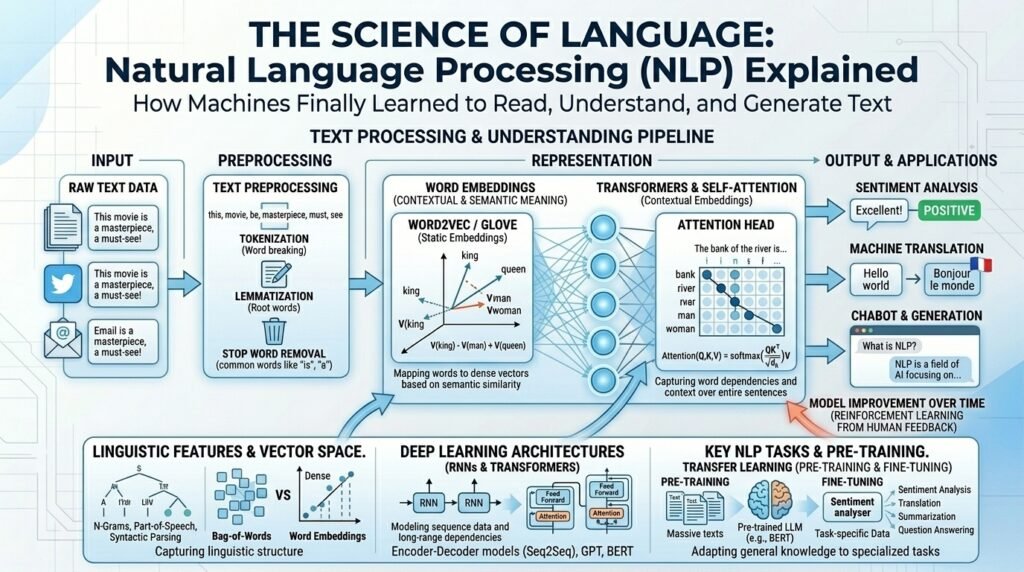
Modern NLP systems often use sub word tokenization — breaking words into meaningful fragments. “Unhappiness” might become [“un”, “happy”, “ness”]. This handles rare words gracefully (you can construct any word from pieces) and keeps the vocabulary manageable. GPT-4 and similar models use a tokenization scheme called Byte-Pair Encoding, where the vocabulary of tokens is built by iteratively merging the most common pairs of characters in the training data.
From Bag-of-Words to Word Embeddings
Early text processing used a representation called Bag-of-Words: represent a document as a count of how many times each word in the vocabulary appears. It ignores grammar and word order entirely — the “bag” metaphor is apt; you shake all the words together and count what you’ve got.
Crude as it sounds, bag-of-words powered a generation of useful applications: spam filters, document classification, basic sentiment analysis. If an email contains “free,” “prize,” “click here,” and “limited offer” at high frequencies, it’s probably spam. You don’t need to understand the sentence to catch that.
But the ceiling was low. Bag-of-words can’t tell you that “car” and “automobile” mean essentially the same thing, or that “not happy” is the opposite of “happy.”
Word embeddings changed this. The breakthrough idea — formalized in a 2013 paper from Google introducing a model called Word2Vec — was that words with similar meanings appear in similar contexts. If you train on enough text and pay attention to which words appear near which other words, you can map each word to a point in a high-dimensional vector space such that similar meanings cluster together.
The classic demonstration: in the embedding space learned by Word2Vec, the vector for “king” minus the vector for “man” plus the vector for “woman” points almost exactly to the vector for “queen.” Meaning had become geometry.
Text Processing Pipeline: At a Glance
| Stage | What Happens | Example |
|---|---|---|
| Tokenization | Text split into units | “I’m running” → [“I”, “‘m”, “running”] |
| Lowercasing / Normalization | Standardize text format | “Running” → “running” |
| Stop Word Removal | Remove common low-info words | Remove “the”, “is”, “a” |
| Stemming / Lemmatization | Reduce words to base form | “running” → “run” |
| Vectorization | Convert tokens to numbers | “cat” → [0.21, -0.54, 0.88, …] |
| Embedding | Map to semantic space | Similar words cluster together |
NLP Models: A History of Getting Smarter
The evolution of NLP models is a story of increasingly sophisticated answers to the same question: how do you capture meaning in a form a computer can use?
Rule-Based Systems: The Early Days
The first NLP systems weren’t statistical at all. They were hand-coded rule libraries. If the text contains words X and Y in pattern Z, classify it as category A.
These systems were brittle but effective in narrow domains. The ELIZA chatbot, created at MIT in the 1960s, could hold surprisingly plausible conversations using simple pattern matching and substitution rules. “I feel sad” → “Why do you feel sad?” The rules looked like understanding without containing any.
The fundamental problem with rule-based systems is maintenance. Language is infinite and ever-changing. No rulebook ever stays complete for long.
Statistical Models: Let the Data Decide
The shift to statistical approaches in the 1990s and 2000s transformed NLP. Instead of hand-crafted rules, you train a model on large datasets of labeled examples and let it learn the patterns from the data.
Naive Bayes classifiers became a workhorse for text classification — spam detection, sentiment analysis, topic labeling. Hidden Markov Models powered part-of-speech tagging (deciding whether “run” in a sentence is a verb or a noun) and early speech recognition. Support Vector Machines handled document classification with impressive accuracy for their time.
These models were more robust than rule-based systems and could handle genuine ambiguity by working with probabilities rather than binary yes/no rules. But they still treated words largely as independent tokens. They couldn’t model the way meaning flows through a sentence — the way the beginning of a sentence conditions what the end can reasonably mean.
Recurrent Neural Networks: Adding Memory
The introduction of neural networks to NLP brought something the earlier models lacked: the ability to process sequences. Recurrent Neural Networks (RNNs) process text word by word, maintaining a hidden state that carries information from earlier in the sequence into later computations. A form of machine reading memory.
This was a genuine improvement. RNNs could model dependencies between words — relating a pronoun back to its antecedent, or connecting a verb to its subject across a long clause. Long Short-Term Memory networks (LSTMs), a refined variant of RNNs, handled longer-range dependencies better and became the standard architecture for language tasks through the mid-2010s.
They powered the first wave of genuinely capable machine translation, early neural text generation, and substantially better speech recognition. But they had an Achilles heel: they processed text sequentially, one word at a time, which made training slow and made it hard to capture relationships between distant words in long documents.
The key innovation was the — a way for the model to look at all words in a sequence simultaneously and dynamically weight how much each word should influence the interpretation of every other word. Instead of reading left to right and hoping important context was still encoded in the hidden state, the Transformer could directly connect any word to any other word in the sequence.
This solved the long-range dependency problem. It also made training massively parallelizable — instead of sequential word-by-word processing, the entire sequence could be processed at once on modern hardware.
The results were transformative. Pre-trained Transformer models like BERT (from Google, 2018) and GPT (from OpenAI, 2018 onward) set new records on virtually every NLP benchmark. Fine-tuned on specific tasks, they outperformed anything that had come before. Trained at even larger scales, they started exhibiting capabilities that surprised even their creators.
NLP Model Evolution: Then vs. Now
| Era | Dominant Approach | Strength | Limitation |
|---|---|---|---|
| 1960s–1980s | Rule-based systems | Precise in narrow domains | Brittle, doesn’t generalize |
| 1990s–2000s | Statistical models | Handles ambiguity probabilistically | Ignores word order and context |
| 2010–2017 | RNNs and LSTMs | Captures sequential dependencies | Slow training, struggles with long range |
| 2017–present | Transformers | Parallel processing, long-range attention | Computationally expensive, data-hungry |
What Modern NLP Can Actually Do
Let’s get concrete. Here’s where NLP models are genuinely changing how things work across industries.
Sentiment Analysis
Businesses use NLP to analyze customer reviews, social media mentions, and support tickets at scale — automatically classifying them as positive, negative, or neutral, and drilling down into which specific aspects (product quality, shipping speed, customer service) sentiment is attached to. A company with a million reviews can now understand the texture of customer feeling in a way that was simply impossible with human reading.
Named Entity Recognition (NER)
NER systems scan text and identify specific categories of entities: people, organizations, locations, dates, monetary values. A financial news service might use NER to automatically tag every article with the companies it mentions, enabling real-time monitoring of how sentiment around a stock correlates with news coverage.
Machine Translation
Google Translate, DeepL, and similar services now run on Transformer-based NLP models trained on hundreds of millions of sentence pairs across dozens of language pairs. The quality has improved so dramatically in the past decade that machine translation has shifted from a punchline to a genuinely useful tool — though it still stumbles on idiom, cultural reference, and poetic nuance.
Question Answering and Search
The shift from keyword search to semantic search is NLP at work. When you type a question into Google and get a direct answer in the featured snippet, a NLP model has read and understood a passage from a webpage well enough to extract the relevant information. Microsoft’s Bing integration with large language models takes this further — generating synthesized answers from multiple sources.
Text Summarization
Long-form content summarization — condensing a 50-page report into a three-paragraph executive summary — is now commercially viable thanks to large language models. Law firms use it for case research. Investment analysts use it for earnings call transcripts. Journalists use it for background research. The quality isn’t always perfect, but it’s good enough to dramatically accelerate workflows that used to be purely human.
The Limitations Nobody Talks About Enough
NLP has made extraordinary progress, but the field’s honest practitioners will tell you the limitations are real and worth understanding.
Hallucination is perhaps the most discussed. Large language models can generate text that sounds authoritative and specific while being factually wrong. They predict words based on patterns, not truth — and sometimes the most statistically plausible-sounding sentence is simply false. This isn’t a bug about to be patched; it reflects something deep about how these systems work.
Bias is endemic. NLP models learn from human text, and human text reflects human prejudice. Models trained on internet text have been shown to associate certain professions with specific genders, produce different quality outputs in different languages, and respond differently to names associated with different ethnicities. These aren’t hypothetical concerns — they’ve been documented repeatedly in published research.
Context windows still limit what models can hold in attention at once. While Transformer context windows have grown dramatically (from hundreds of tokens to hundreds of thousands), there remain tasks — understanding a full-length novel, reasoning across an entire codebase — where even the largest models strain.
Genuine understanding versus sophisticated pattern matching is a philosophical question with practical stakes. When an NLP model answers a question correctly, did it understand the question, or did it find a sufficiently similar pattern in its training data? The distinction matters in high-stakes applications — medical advice, legal reasoning, crisis intervention — where the difference between pattern completion and actual comprehension could have serious consequences.
What’s Next in NLP
A few developments worth watching:
Multimodal models combine language understanding with other modalities — images, audio, video, structured data. Instead of a language model that only reads text, these systems understand how a caption relates to an image, or how spoken language relates to the video it accompanies. GPT-4o and Google’s Gemini represent early steps in this direction.
Retrieval-augmented generation (RAG) addresses the hallucination and currency problems by giving language models access to external knowledge bases at inference time — instead of relying only on what was baked in during training. The model retrieves relevant documents, reads them, and generates answers grounded in specific sources. This hybrid approach is rapidly becoming the standard for enterprise NLP applications.
Smaller, efficient models are a growing focus. Not every task requires a model with hundreds of billions of parameters. Distillation techniques compress the knowledge of large models into much smaller ones that can run locally, on-device, with minimal energy cost. This is important for privacy, latency, and environmental sustainability.
Better evaluation is quietly becoming a major research priority. One reason NLP progress has sometimes felt faster than it actually is: benchmark datasets get “solved” by models that learn the test rather than the task. Building evaluation methods that actually measure what we care about — genuine understanding, reliability, calibration — is harder than it sounds and more important than it gets credit for.
Frequently Asked Questions
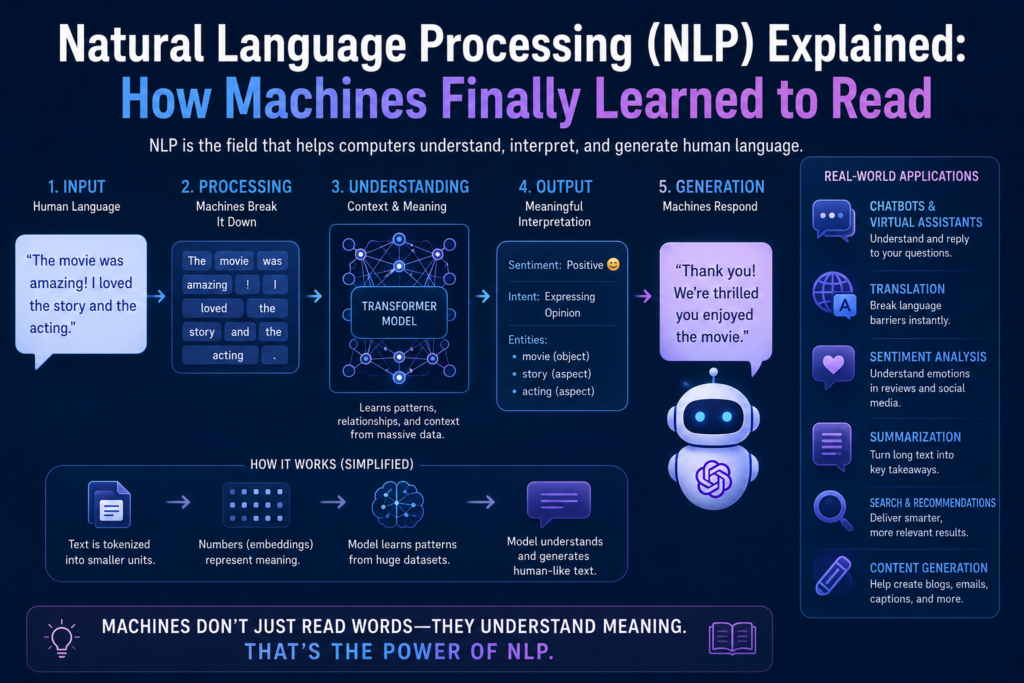
Q: What is Natural Language Processing in simple terms? NLP is the field of AI that focuses on helping computers understand, interpret, and generate human language. It powers everything from spell-checkers and voice assistants to translation tools and chatbots. The goal is to bridge the gap between how humans communicate naturally and the structured, numerical way computers process information.
Q: What’s the difference between NLP and a large language model (LLM)? NLP is the broad field — it encompasses all techniques for processing and understanding language, from simple rule-based systems to neural networks. A large language model is a specific type of NLP model: a very large Transformer-based neural network trained on enormous amounts of text. LLMs are currently the most capable NLP systems, but they’re one approach within a much larger field that includes many other techniques and applications.
Q: How does text processing work in practice? Raw text goes through several stages before a model can use it. It’s tokenized (split into units), normalized (standardized formatting), and converted into numerical representations (vectors or embeddings). These numerical representations are what the model actually processes. The quality of this pipeline significantly affects the quality of downstream results — garbage in, garbage out applies as much to NLP as to any other computational system.
Q: Why do NLP models sometimes get things wrong even when they seem confident? Because they’re predicting what text should come next based on patterns in training data — not reasoning from facts or verified knowledge. High confidence in an NLP model reflects statistical regularity, not epistemic certainty. A sentence can be highly probable given the preceding context and still be false. This is why fact-checking the outputs of language models in high-stakes contexts isn’t optional caution — it’s necessary practice.
Q: Is NLP the same as speech recognition? Related but distinct. Speech recognition converts audio signals into text — that’s primarily a signal processing and acoustic modeling problem. NLP then operates on that text. In a voice assistant like Siri or Alexa, speech recognition handles “turn audio into words” and NLP handles “understand what those words mean and determine an appropriate response.” The two fields increasingly overlap in end-to-end systems, but they address different parts of the pipeline.
Q: What industries are most transformed by NLP right now? Healthcare (clinical note processing, medical literature search, patient communication), legal (contract analysis, case research, document review), finance (earnings analysis, fraud detection, regulatory compliance), customer service (chatbots, ticket routing, sentiment monitoring), and media (content recommendation, automated summarization, translation) are all seeing significant NLP-driven transformation. The common thread: any industry that processes large volumes of unstructured text at scale is a candidate for NLP impact.
Q: How can I start learning NLP as a beginner? Start with the conceptual foundations — what tokenization, embeddings, and attention mechanisms do — before diving into code. Hugging Face’s free NLP course is one of the best practical introductions available; it combines theory with hands-on use of state-of-the-art models. If you want the mathematical depth underneath, pair it with the Stanford CS224N lecture series (freely available on YouTube). Python is the language of the field — if you’re not already comfortable with it, that’s the prerequisite worth addressing first.
A Final Thought
Language is where human intelligence is most visible. It’s how we reason out loud, how we pass knowledge between generations, how we negotiate meaning with each other. Teaching machines to work with language isn’t just a technical achievement — it’s a cultural one.
NLP hasn’t solved language. The models we have are remarkable but imperfect: confident without always being correct, capable without always being reliable, impressive without always being trustworthy. Understanding those limitations is as important as appreciating the genuine breakthroughs.
What’s already clear is that the relationship between humans and written language is changing. The tools we use to search, write, translate, summarize, and communicate are being rebuilt from the inside out. And having even a basic understanding of how NLP models and text processing work puts you in a far better position to use these tools well, question them critically, and form your own views about where they should and shouldn’t be trusted.
The machines learned to read. Now it’s worth understanding exactly what that means.
Want to go deeper? Hugging Face’s free NLP course at huggingface.co/learn is the best practical starting point available — you’ll be running real NLP models within the first hour.