Nobody tells you this when you first get excited about machine learning: at some point, the abstraction runs out.
You can only go so far reading about “algorithms that learn from data” before someone drops a matrix equation in front of you and the whole thing suddenly feels like a foreign language. For a lot of people smart, capable people that’s where the enthusiasm quietly deflates.
Which is a shame. Because the math behind machine learning, once you see what it’s actually doing, is less intimidating than it looks. It’s not arbitrary symbol shuffling. Every piece of it every vector, every derivative, every probability is answering a specific, sensible question. And when you understand the questions, the symbols start making sense on their own.
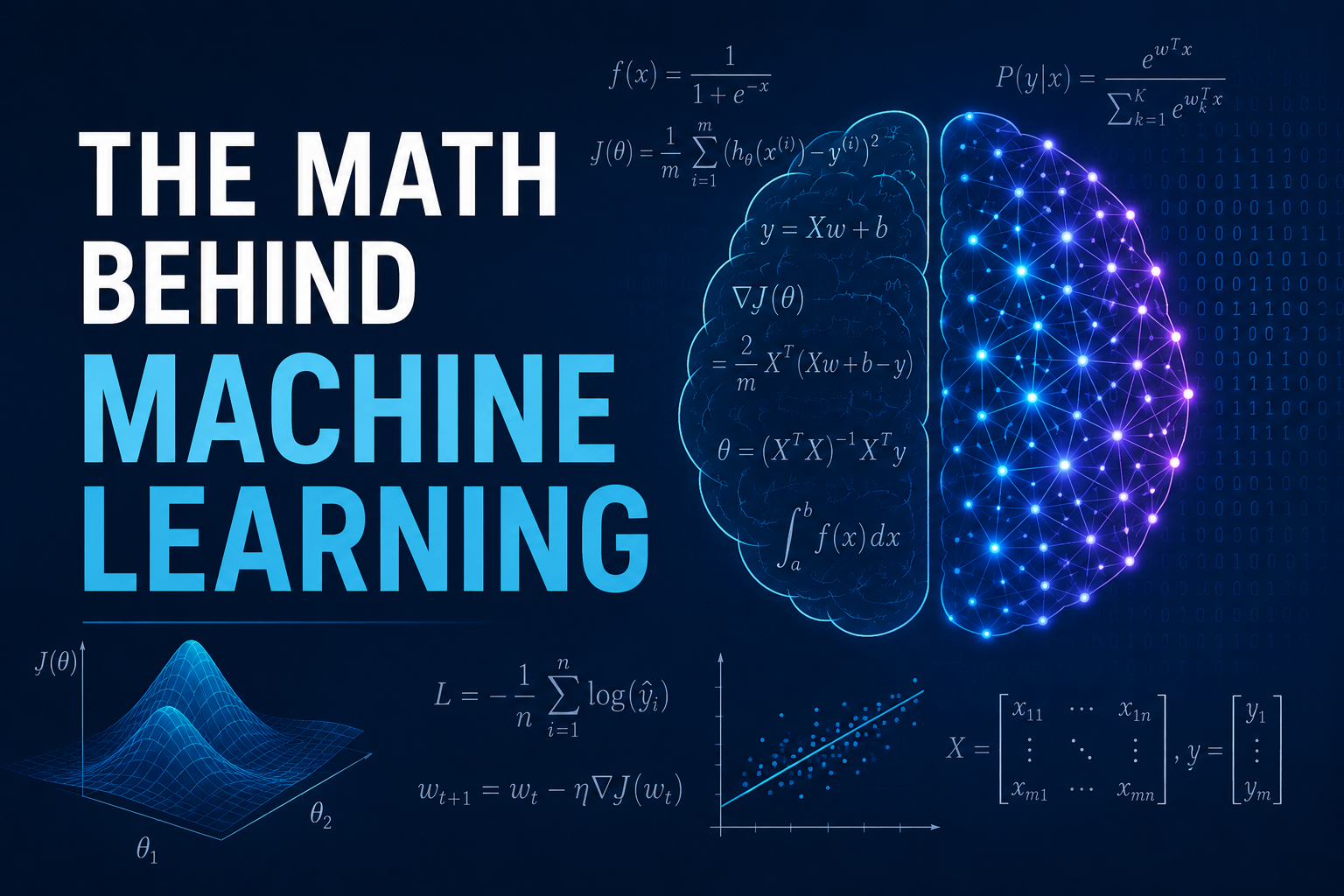
This article is for anyone who’s ever felt that deflation. We’re going to walk through the core mathematics that powers modern machine learning: linear algebra, calculus, probability, and optimization. No PhD required. Some patience, though yes.
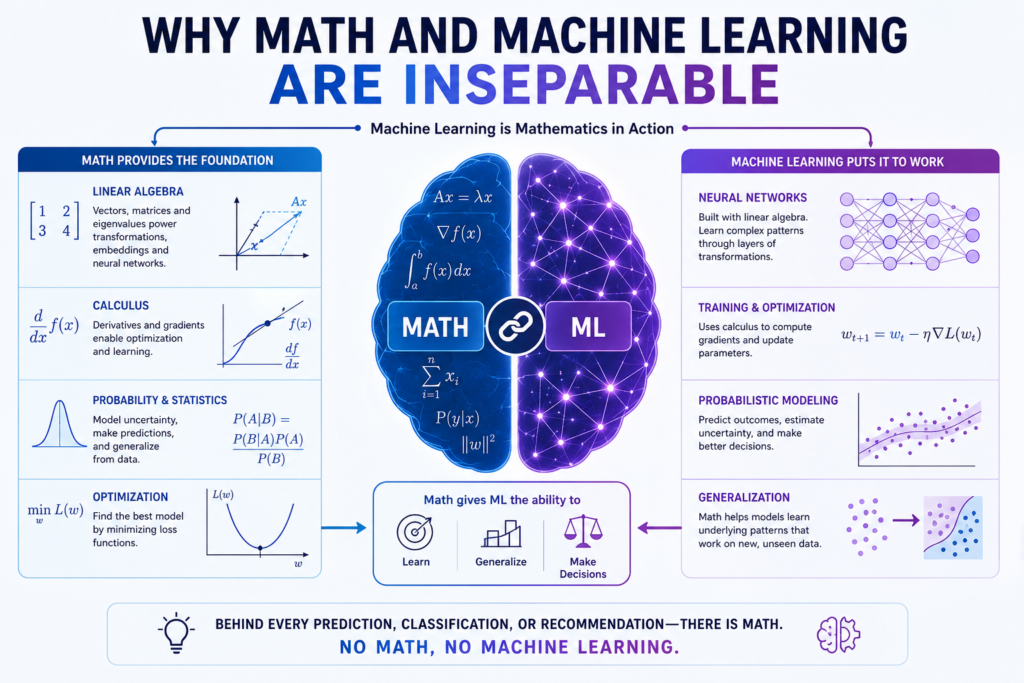
Why Math and Machine Learning Are Inseparable
Here’s the honest version: machine learning is applied mathematics. Full stop.
The “learning” in machine learning isn’t mystical. It’s a mathematical process of adjusting numbers millions of them until a system gets reliably good at a task. Whether that task is recognizing speech, recommending products, or detecting fraud, the underlying engine is the same: a structured set of mathematical operations running on data.
Understanding this doesn’t make the field less impressive. If anything, it makes it more so. Because once you see the elegance of how a few core mathematical ideas combine to produce something as sophisticated as a language model or an image classifier, the whole thing becomes genuinely fascinating rather than vaguely magical.
Let’s start at the foundation.
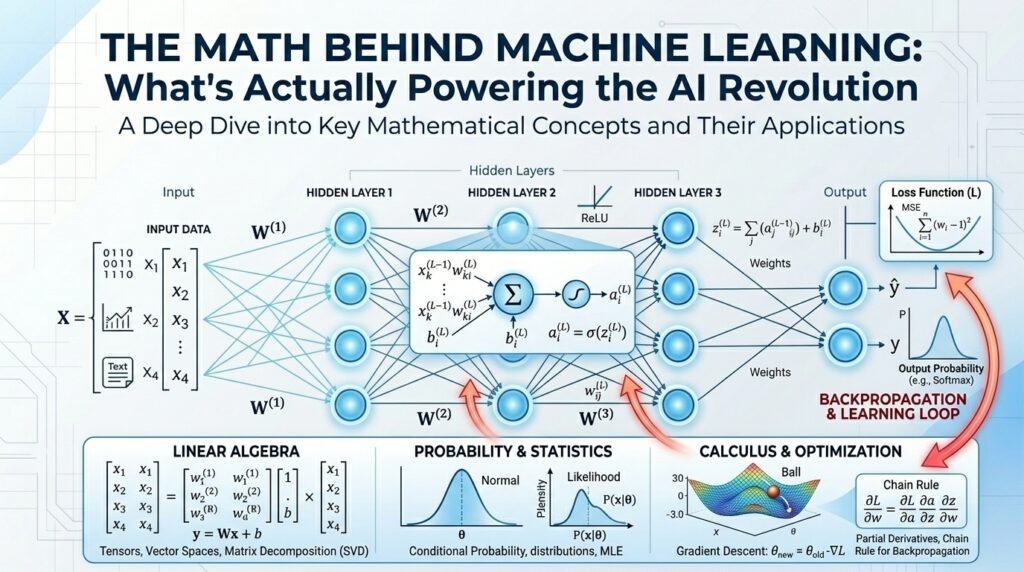
Linear Algebra: The Language Machines Speak
If machine learning has a native language, it’s linear algebra. Specifically, it’s the mathematics of vectors and matrices — and understanding these two concepts unlocks an enormous amount of what’s happening under the hood.
What Is a Vector?
A vector is just an ordered list of numbers. That’s it.
If you’ve ever seen coordinates on a map — (3, 7) — you’ve worked with a two-dimensional vector. In machine learning, vectors are used to represent data points. An email might be represented as a vector where each number corresponds to how many times a particular word appears. A photo might be represented as a vector of pixel values. A customer profile might be a vector of purchase history, location, age, and browsing behavior.
The power of representing things as vectors is that you can do math with them. You can measure how similar two vectors are (are these two emails alike?), how far apart they are (how different are these two customers?), and how to transform them (how do I adjust this input to get the output I want?).
What Is a Matrix?
A matrix is a grid of numbers — rows and columns. Think of a spreadsheet. Each row might be a data point, each column a feature.
In machine learning, matrices are everywhere. The weights of a neural network layer — the numbers that determine how much influence each input has on each output — are stored as a matrix. Operations like passing data through a neural network are, mathematically, sequences of matrix multiplications.
This is why GPUs (graphics cards) became the hardware of choice for AI. GPUs were originally designed to handle the enormous number of matrix operations needed to render 3D graphics. Turns out, training neural networks needs exactly the same kind of parallel mathematical horsepower.
Why Linear Algebra for AI Matters in Practice
| Concept | What It Represents in ML | Example Use |
|---|---|---|
| Vector | A single data point or set of features | A user’s listening history on Spotify |
| Matrix | A dataset or a layer of weights | All training images as pixel grids |
| Dot Product | Similarity between two vectors | Comparing a search query to documents |
| Matrix Multiplication | Transforming data through a layer | Forward pass in a neural network |
| Transpose | Flipping rows and columns | Reshaping data for computation |
The dot product deserves special mention. It’s the operation of multiplying corresponding elements of two vectors and summing the results — and it shows up constantly. When a neural network computes how “activated” a neuron should be, it’s taking a dot product. When a recommendation system measures how closely your taste matches a song’s features, it’s taking a dot product. It’s one of the most useful operations in all of machine learning math.
Calculus: Teaching Machines to Improve
If linear algebra is the language, calculus is the engine of learning.
More specifically, it’s a branch of calculus called differential calculus — the mathematics of rates of change — that makes the “learning” in machine learning actually work.
The Problem Calculus Solves
Imagine you’re trying to tune a radio. You’re turning the dial, listening to the static and signal mix, trying to find the clearest reception. You adjust a little left — better. A little more left — worse. So you nudge back right. This back-and-forth, guided by feedback, is essentially what a machine learning model does during training.
The model makes a prediction, measures how wrong it was, and adjusts its internal settings (weights) to do better next time. The question is: which direction should you adjust, and by how much?
That’s where calculus comes in.
Derivatives and Gradients
A derivative measures how much a function’s output changes when you tweak its input. If you’ve ever calculated the slope of a line, you’ve computed a simple derivative.
In machine learning, we’re interested in the derivative of the loss function — the measure of how wrong the model’s predictions are — with respect to each weight in the network. This tells us: if I nudge this weight slightly, does the error go up or down?
When you extend this idea to functions with many inputs (and neural networks can have billions of weights), the derivative becomes a gradient — a vector pointing in the direction of steepest increase in the loss. To reduce the error, you move in the opposite direction.
This process has a name you’ve probably heard: gradient descent.
Gradient Descent: The Heart of Machine Learning
Gradient descent is the algorithm that trains virtually every modern machine learning model. The intuition is beautifully simple.
Imagine you’re blindfolded in a hilly landscape and you want to find the lowest valley. You can’t see anything, but you can feel the slope under your feet. So you take a step in whichever direction feels downhill. Then another. Then another. Eventually — if the landscape cooperates — you reach the bottom.
In mathematical terms: you compute the gradient of the loss (which direction is “uphill”), and you take a step in the opposite direction. Repeat until the loss stops decreasing meaningfully.
The size of each step is controlled by a parameter called the learning rate. Too large, and you overshoot the valley and bounce around erratically. Too small, and training takes forever. Choosing the right learning rate is as much art as science — which is one reason ML engineering is a genuine skill, not just running code.
Calculus in ML: A Quick Reference
| Concept | What It Does | Why It Matters |
|---|---|---|
| Derivative | Measures rate of change | Tells us how sensitive loss is to each weight |
| Gradient | Multidimensional derivative | Points the direction of steepest error increase |
| Gradient Descent | Iterative optimization algorithm | The core training loop for most ML models |
| Learning Rate | Step size during optimization | Controls training speed and stability |
| Backpropagation | Applies chain rule through layers | How gradients are computed in neural networks |
Backpropagation is worth naming specifically. It’s the algorithm that applies gradient descent through the layers of a neural network — working backward from the output to efficiently compute how every weight contributed to the error. Without backpropagation, training deep networks would be computationally infeasible. It’s arguably the most important algorithm in modern AI.
Probability and Statistics: How Machines Handle Uncertainty
Here’s something that often surprises people: most machine learning models aren’t making definitive decisions. They’re making probabilistic estimates.
When a spam filter labels an email as spam, it’s not saying “this is definitely spam.” It’s saying “based on the patterns I’ve learned, there’s an 97% probability this is spam.” That’s a fundamentally different claim — and probability theory is what makes that kind of reasoning possible.
The Basics That Matter
Probability measures the likelihood of an event — a number between 0 (impossible) and 1 (certain). In ML, we’re often interested in conditional probability: given what I’ve already observed, what’s the probability of this outcome?
Bayes’ Theorem is the mathematical rule for updating probabilities based on new evidence. It’s the foundation of a whole class of ML algorithms called Bayesian methods, and it’s also a surprisingly good model for how rational reasoning works in general. Spam filters, medical diagnostics tools, and even some search ranking systems have Bayesian logic at their core.
Distributions describe how probabilities are spread across possible outcomes. The bell curve — formally called the normal distribution — shows up everywhere in statistics and machine learning, partly because of a remarkable mathematical result called the Central Limit Theorem: averages of large samples tend toward a normal distribution, regardless of the underlying data’s shape.
Why Probability Matters for Machine Learning Math
The connection between probability and machine learning runs deep. Many loss functions used in training — including cross-entropy loss, the standard for classification tasks — are derived from probabilistic principles. When a model learns to minimize cross-entropy loss, it’s mathematically equivalent to maximizing the likelihood that its predictions match the true data distribution.
That’s not just a technical footnote. It means the math of training a neural network is grounded in a coherent statistical framework. The model is genuinely trying to find the best probabilistic description of the patterns in the data.
Optimization: Putting It All Together
Optimization is where linear algebra, calculus, and probability converge into something practical.
At its core, machine learning is an optimization problem: find the set of weights that minimizes the loss function on the training data while still generalizing well to new data. Everything else — the architectures, the training procedures, the regularization techniques — exists in service of solving that problem better.
The Loss Function
The loss function (sometimes called the cost function) is the mathematical measure of how wrong a model’s predictions are. Choosing the right loss function depends on the task.
| Task Type | Common Loss Function | What It Measures |
|---|---|---|
| Binary Classification | Binary Cross-Entropy | How far predicted probabilities are from true labels |
| Multi-class Classification | Categorical Cross-Entropy | Probability error across multiple categories |
| Regression | Mean Squared Error (MSE) | Average squared difference between predictions and actuals |
| Object Detection | IoU + Classification Loss | Localization error combined with category error |
| Language Generation | Cross-Entropy over tokens | How well the model predicts the next word |
Overfitting: When the Math Works Too Well
Here’s one of the genuinely counterintuitive lessons in machine learning: a model can get too good at its training data and become worse at everything else.
This is called overfitting. The model memorizes the training examples — noise and all — instead of learning the underlying patterns. On training data, its loss is tiny. On new data, it falls apart.
The mathematical fix involves regularization — adding penalty terms to the loss function that discourage the model from becoming too complex. L1 and L2 regularization are the most common forms. L2 (also called Ridge) penalizes large weights by adding the sum of squared weights to the loss. It nudges the model toward simpler, more generalizable solutions.
Dropout — randomly zeroing out neurons during training — is another regularization technique specific to neural networks. It forces the network to learn redundant representations, making it more robust. Mathematically, it can be interpreted as training an ensemble of many different networks simultaneously.
Where the Math Shows Up in the Real World
This isn’t abstract. These mathematical ideas are producing real, measurable outcomes across industries right now.
In healthcare, optimization algorithms trained on medical imaging data are helping radiologists detect cancers earlier. A 2020 study published in Nature found that a deep learning model reduced false positives in breast cancer screening by 5.7% compared to human radiologists alone — a difference that translates to real lives.
In finance, gradient descent-trained models analyze thousands of transaction features simultaneously to flag fraud in milliseconds. The matrix operations that represent transaction data are being multiplied through dozens of neural network layers, each transformation extracting subtler patterns, before a final probability score determines whether to flag or approve.
In language technology, the Transformer architecture — the mathematical backbone of GPT, Claude, and most modern language models — uses a mechanism called self-attention that is, at its core, a sophisticated series of matrix multiplications and dot products. Every time a language model generates a sentence, it’s performing billions of these operations.
The math isn’t separate from the magic. It is the magic.
Do You Actually Need to Learn All This?
Honest answer: it depends on what you want to do.
If you want to use machine learning tools — build applications, work with APIs, integrate AI into products — you can go a long way without deep mathematical knowledge. The frameworks do the calculus for you. You need intuition more than derivations.
If you want to research or build novel ML systems — design new architectures, develop new training methods, push the field forward — then yes. The math is non-negotiable. You need to understand what gradient descent is actually doing to know how to fix it when it misbehaves.
And if you just want to understand what’s happening inside these systems — to be a more informed practitioner, a better critic, or simply a more curious person — then learning the math pays dividends far beyond the technical. It gives you a vocabulary for the most consequential technology of our era.
Frequently Asked Questions
Q: What math do I actually need to start learning machine learning? Start with linear algebra (vectors, matrices, dot products) and basic calculus (derivatives, the idea of a gradient). Add probability fundamentals — probability rules, Bayes’ theorem, common distributions. That trio covers the core of most introductory ML. Statistics deepens your understanding but isn’t a prerequisite for getting started.
Q: Is machine learning math harder than regular university math? The individual concepts aren’t unusually difficult. What makes it feel hard is the combination — you need linear algebra, calculus, and probability all working together, applied to systems with millions of parameters. The concepts themselves are teachable. Building intuition for how they interact takes time and practice.
Q: Can I learn machine learning without being good at math? You can build a working knowledge of applied ML — using libraries, training models, interpreting results — without deep mathematical fluency. But there’s a ceiling. When things break, when you need to debug training instability, when you want to understand why a model behaves a certain way, the math is what gives you the tools to investigate. It’s worth developing, even incrementally.
Q: What resources are best for learning the math side of ML? Three strong options: Mathematics for Machine Learning by Deisenroth, Faisal, and Ong (free online, rigorous but accessible), 3Blue1Brown’s YouTube series on linear algebra and calculus (extraordinary visual intuition), and fast.ai’s courses (math taught in context, applied immediately to real problems). The combination of visual and applied learning tends to stick better than pure textbook study.
Q: How is calculus used differently in ML than in traditional math classes? In school, calculus is often taught analytically — you derive formulas and solve them exactly. In machine learning, calculus is used computationally. You don’t solve gradient descent analytically; you approximate it iteratively, stepping toward better solutions rather than jumping to the exact answer. The conceptual goal is the same (understand rates of change), but the application is fundamentally numerical rather than symbolic.
A Final Thought
There’s a tendency to treat the mathematics of machine learning as a barrier — the toll you pay before you’re allowed into the field. That framing does everyone a disservice.
The math isn’t a hurdle. It’s the explanation. It’s the reason a model trained on cat photos can suddenly recognize dogs it’s never seen. It’s the reason a language model can complete a sentence in a style it learned from a million books. It’s the reason gradient descent, run long enough on enough data, produces something that looks startlingly like understanding.
You don’t have to master all of it to benefit from machine learning. But the more of the math you understand, the more of the technology you actually see — not as a black box performing tricks, but as a coherent, elegant system doing exactly what the equations say it should.
And that, honestly, is a more satisfying relationship with the tools shaping our world.
Ready to go deeper? Start with 3Blue1Brown’s Essence of Linear Algebra series on YouTube — 15 short videos that will change how you see matrices forever. Then come back to the calculus. It lands differently once the algebra makes visual sense.
FAQ
| Category | Questions Covered |
|---|---|
| General Understanding | Math prerequisites, difficulty level, single most important concept |
| Linear Algebra | Why matrices matter, what a dot product is, whether you need eigenvalues |
| Calculus & Optimization | Backpropagation explained, learning rate pitfalls, SGD vs mini-batch |
| Probability & Statistics | Why probability over yes/no answers, Bayes’ Theorem in plain English |
| Practical Application | Best learning resources, realistic timeline, code vs. theory |
R
Read more about neural structures and ai on our website.